
Real numbers
Classifying real numbers worksheets
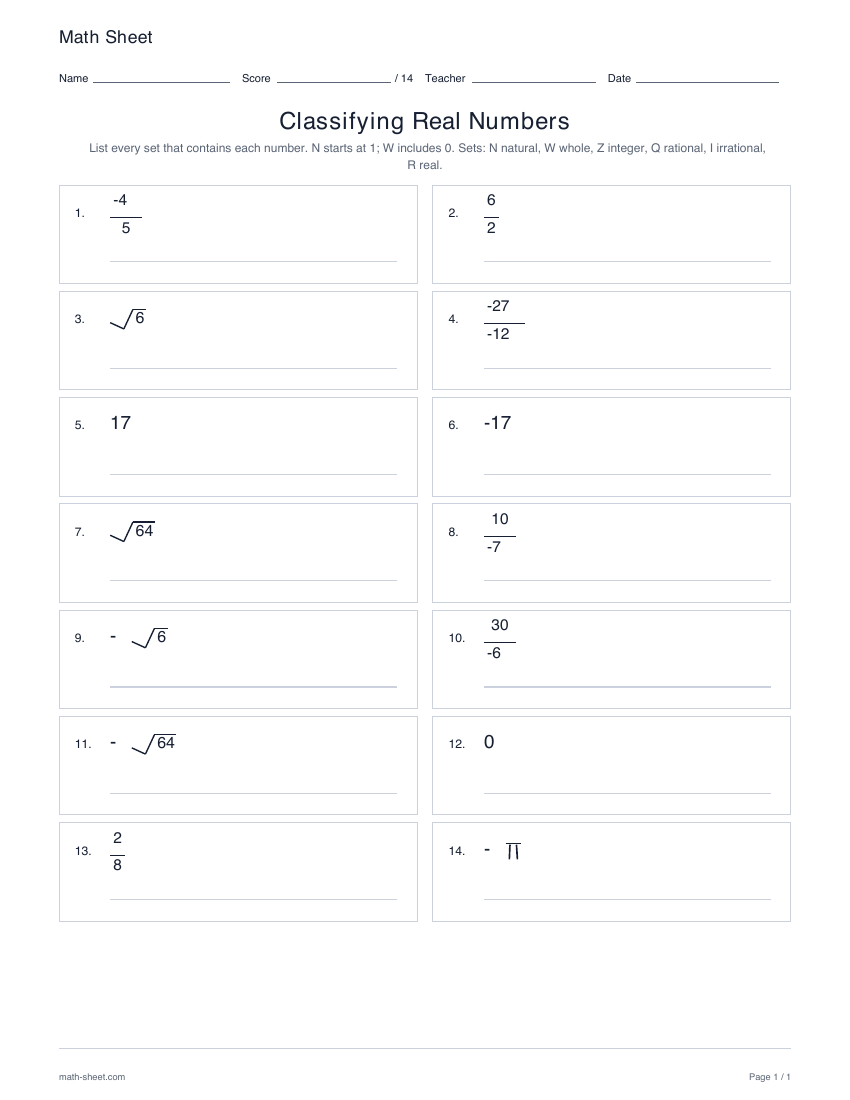
Classify fourteen values into every applicable number set. Compare integers, reducible and irreducible signed fractions, square roots and pi with a separate answer key.
Preview and downloadUnderstand the value. Read the sign.
Build a clear picture of the number sets, then practice calculating with signed numbers. Choose a focused worksheet and print the same questions with a separate key.
Choose a practice sheetBuild the next skill
Classify the value, even when a fraction or root disguises it.
Real numbers
Classify fourteen values into every applicable number set. Compare integers, reducible and irreducible signed fractions, square roots and pi with a separate answer key.
Preview and downloadBuild the next skill
Choose sums and differences, integer notation practice, or mixed rational multiplication and division.
Real numbers
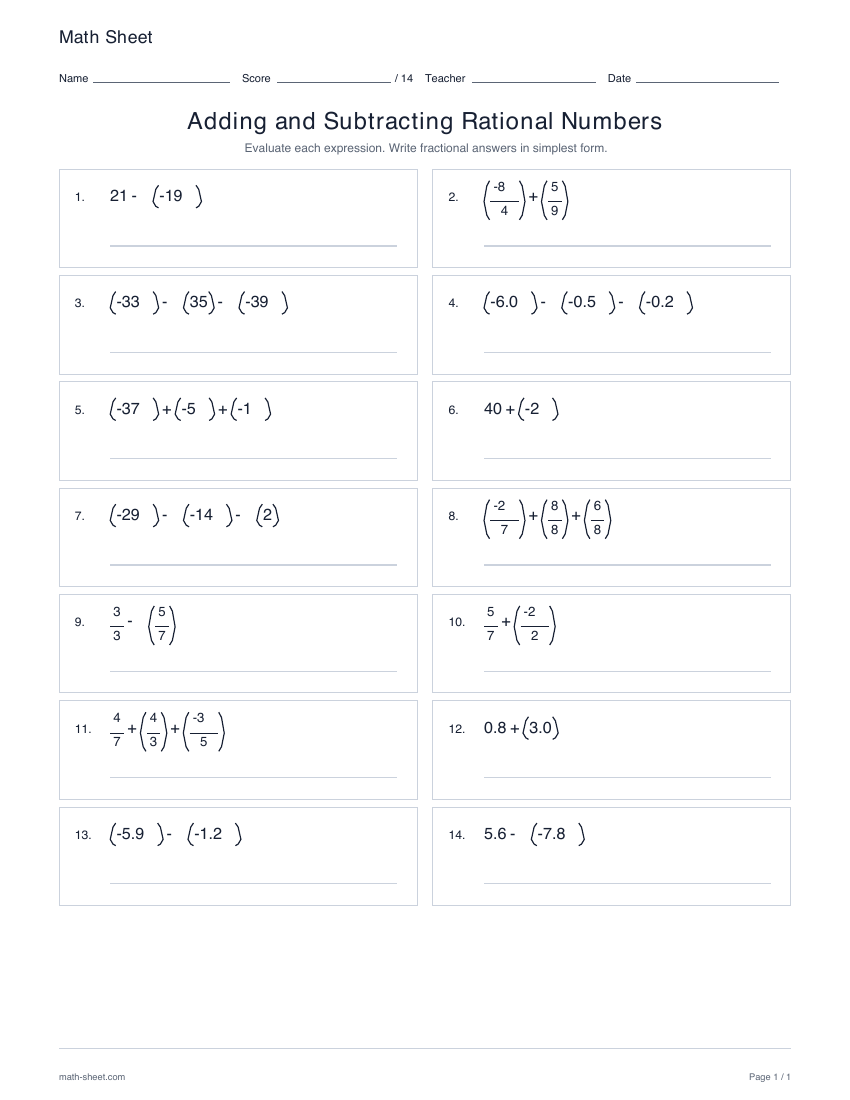
Create fourteen signed sums and differences with integers, decimals, fractions or a mixture. Each question has two or three operands and an exact answer.
Preview and download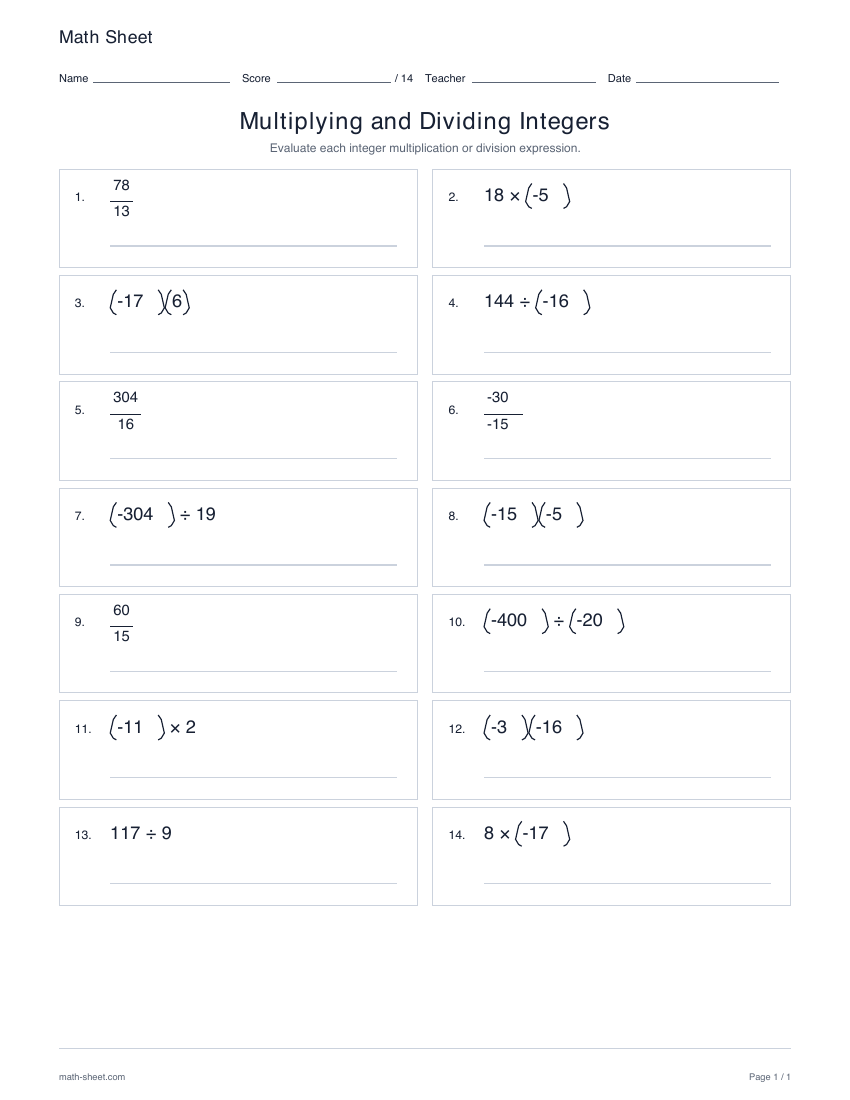
Real numbers
Practice fourteen signed integer products and exact quotients. Choose fraction-bar division, ÷, × or parentheses, with factor magnitudes from 2 to 20.
Preview and download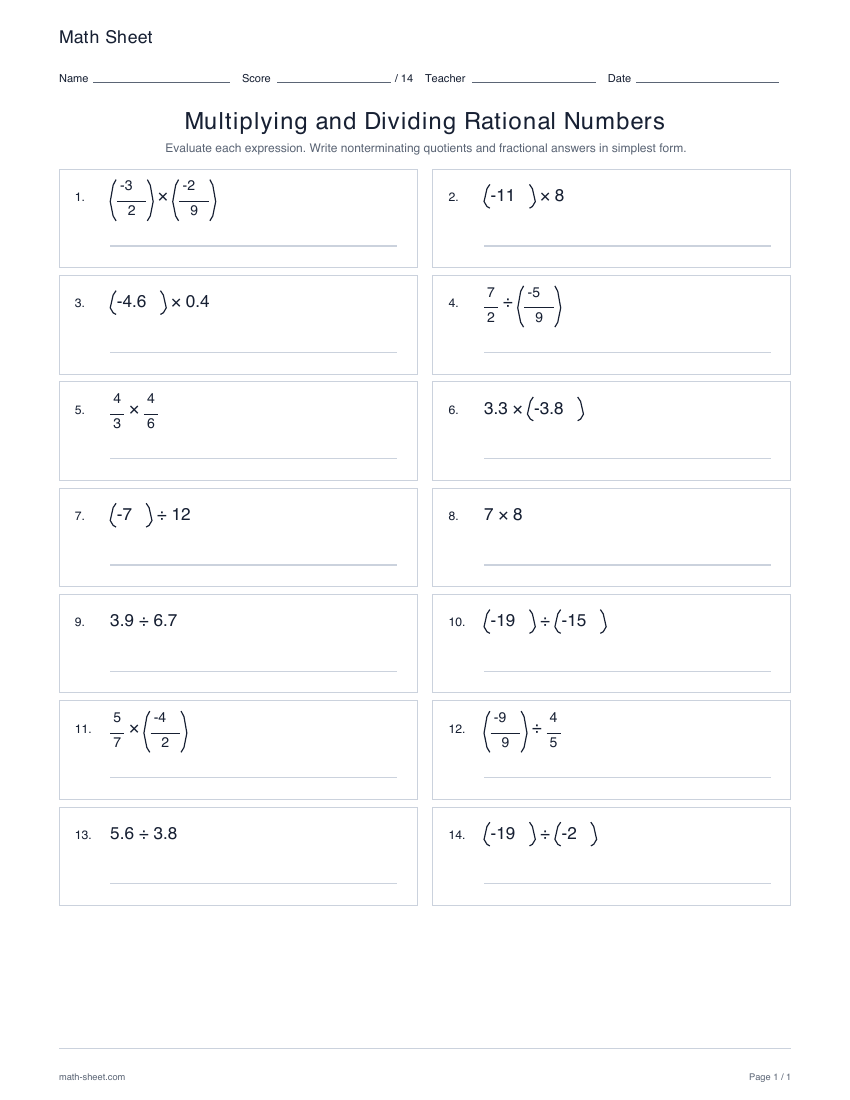
Real numbers
Create fourteen signed products and quotients with any combination of integers, decimal tenths and fractions. Exact answers use terminating decimals or simplest fractions.
Preview and downloadIsolate one skill, then combine settings when the learner is ready. These links configure the same worksheets without creating a new activity.
Compare signed fractions that simplify to integers with fractions that remain nonintegers, alongside roots and pi.
Open this practice →Practice positive and negative sums and differences before introducing fractions.
Open this practice →Work with signed decimal operands and preserve place value.
Open this practice →Combine signed fractions and write the result in simplest form.
Open this practice →Connect a fraction bar with the division sign using familiar fact magnitudes.
Open this practice →Compare the multiplication sign with adjacent parentheses using larger factors.
Open this practice →Practice signed integer, decimal and fraction products and quotients on one sheet.
Open this practice →A fraction does not always represent a noninteger. The value −18/−3 is 6, so it is natural, whole, integer, rational and real. In contrast, 5/3 is rational and real but is not an integer.
A square-root symbol does not automatically mean irrational. The principal square root √36 is 6; √37 is irrational because 37 is not a perfect square.
The classification worksheet asks for every applicable set. Its legend defines natural numbers as 1, 2, 3, … and whole numbers as 0, 1, 2, 3, … .
In −4 − (−7), the middle minus sign means subtraction and the other signs belong to the numbers. Adding the opposite gives −4 + 7 = 3.
Both (−4) × (−7) and (−4)(−7) mean multiplication. Their product is 28. Parentheses also keep each negative factor together.
28 ÷ (−7) = −4. Writing 28 over −7 as a stacked fraction represents the same calculation. Multiply the quotient by the divisor to check.
Conventions differ. These worksheets define natural numbers as starting at 1 and whole numbers as starting at 0. The printed legend states that convention, so zero belongs to W, Z, Q and R.
The number sets overlap. Every natural number is whole, every whole number is an integer, and every integer is rational and real. Listing only N leaves out the larger sets.
You can include integers, decimal tenths and fractions on one sheet. Each individual sum or difference uses one number type, which keeps the focus on signed arithmetic.
It controls the magnitudes of factors and divisors, along with the constructed quotient. A dividend is built from two factors, so it can be larger than the selected range.
Yes. The rational-number multiplication and division sheet can combine signed fractions with integer and decimal questions, while the focused multiplication and division worksheets provide fraction-only practice.
All real-number activities support Letter and A4. The new mixed rational multiplication and division activity is English-only; the three earlier activities continue to support English, German, Albanian, Spanish, Italian, French, Turkish and Norwegian Bokmål. Ready-made PDFs are English.
Apply the sign rules while deciding which calculation comes first.
Practice order of operations →Substitute known values and calculate carefully with the resulting signed numbers.
Practice substitution →Review the basic skills before moving to complex numbers.
Explore Algebra 2 practice →