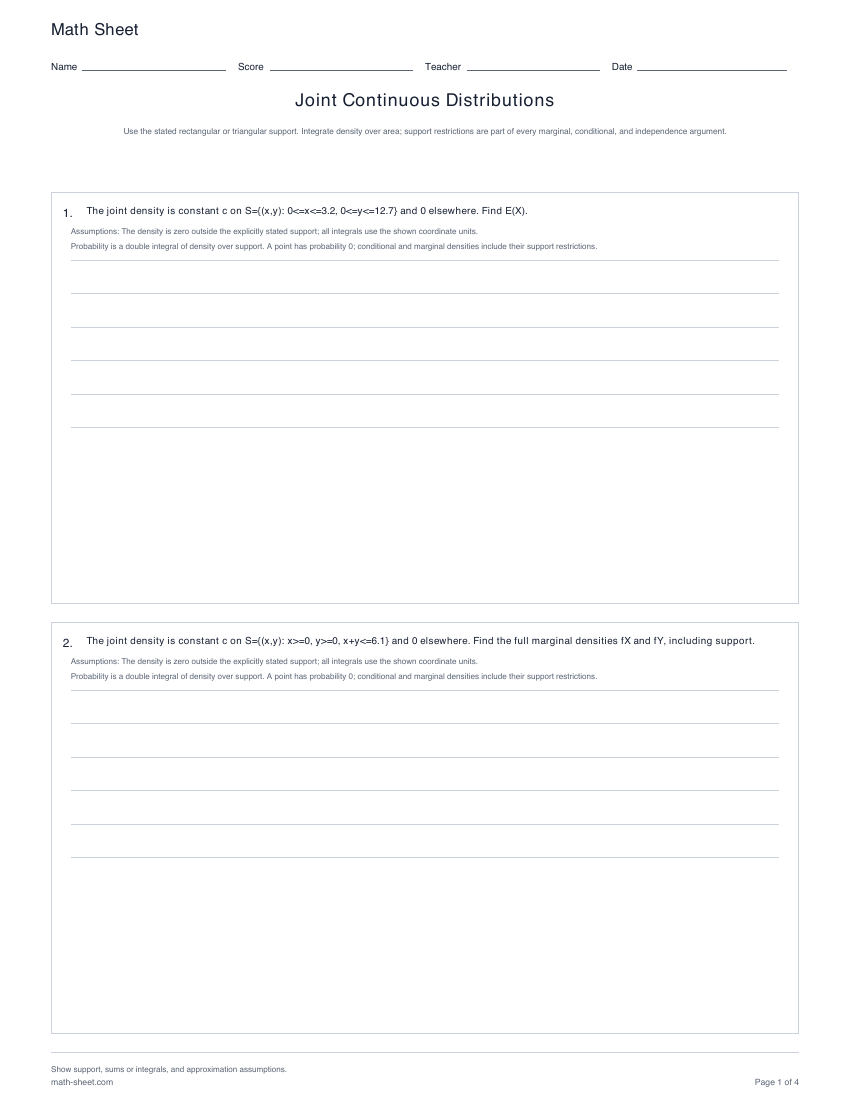
Math Sheet Name Score Teacher Date Joint Continuous Distributions Use the stated rectangular or triangular support. Integrate density over area; support restrictions are part of every marginal, conditional, and independence argument. 1. The joint density is constant c on S={(x,y): 0<=x<=3.2, 0<=y<=12.7} and 0 elsewhere. Find E(X). Assumptions: The density is zero outside the explicitly stated support; all integrals use the shown coordinate units. Probability is a double integral of density over support. A point has probability 0; conditional and marginal densities include their support restrictions. 2. The joint density is constant c on S={(x,y): x>=0, y>=0, x+y<=6.1} and 0 elsewhere. Find the full marginal densities fX and fY, including support. Assumptions: The density is zero outside the explicitly stated support; all integrals use the shown coordinate units. Probability is a double integral of density over support. A point has probability 0; conditional and marginal densities include their support restrictions. Show support, sums or integrals, and approximation assumptions. math-sheet.com Page 1 of 4
Math Sheet Name Score Teacher Date Joint Continuous Distributions Use the stated rectangular or triangular support. Integrate density over area; support restrictions are part of every marginal, conditional, and independence argument. 3. The joint density is constant c on S={(x,y): 0<=x<=4.4, 0<=y<=11.5} and 0 elsewhere. Find P(X<=2.2, Y<=5.75). Assumptions: The density is zero outside the explicitly stated support; all integrals use the shown coordinate units. Probability is a double integral of density over support. A point has probability 0; conditional and marginal densities include their support restrictions. 4. The joint density is constant c on S={(x,y): 0<=x<=8.4, 0<=y<=7.5} and 0 elsewhere. Find c. Assumptions: The density is zero outside the explicitly stated support; all integrals use the shown coordinate units. Probability is a double integral of density over support. A point has probability 0; conditional and marginal densities include their support restrictions. Show support, sums or integrals, and approximation assumptions. math-sheet.com Page 2 of 4
Math Sheet Name Score Teacher Date Joint Continuous Distributions Use the stated rectangular or triangular support. Integrate density over area; support restrictions are part of every marginal, conditional, and independence argument. 5. The joint density is constant c on S={(x,y): 0<=x<=8.2, 0<=y<=7.7} and 0 elsewhere. Find F(4.1,3.85)=P(X<=4.1,Y<=3.85) Assumptions: The density is zero outside the explicitly stated support; all integrals use the shown coordinate units. Probability is a double integral of density over support. A point has probability 0; conditional and marginal densities include their support restrictions. 6. The joint density is constant c on S={(x,y): 0<=x<=2.4, 0<=y<=13.5} and 0 elsewhere. Find the full conditional density f(Y | X=1.2), including values outside conditional support. Assumptions: The density is zero outside the explicitly stated support; all integrals use the shown coordinate units. Probability is a double integral of density over support. A point has probability 0; conditional and marginal densities include their support restrictions. Show support, sums or integrals, and approximation assumptions. math-sheet.com Page 3 of 4
Math Sheet Name Score Teacher Date Joint Continuous Distributions Use the stated rectangular or triangular support. Integrate density over area; support restrictions are part of every marginal, conditional, and independence argument. 7. The joint density is constant c on S={(x,y): x>=0, y>=0, x+y<=12.1} and 0 elsewhere. Are X and Y independent? Use density and support reasoning. Assumptions: The density is zero outside the explicitly stated support; all integrals use the shown coordinate units. Probability is a double integral of density over support. A point has probability 0; conditional and marginal densities include their support restrictions. 8. The joint density is constant c on S={(x,y): 0<=x<=13, 0<=y<=2.9} and 0 elsewhere. Find P(X<=6.5, Y<=1.45). Assumptions: The density is zero outside the explicitly stated support; all integrals use the shown coordinate units. Probability is a double integral of density over support. A point has probability 0; conditional and marginal densities include their support restrictions. Show support, sums or integrals, and approximation assumptions. math-sheet.com Page 4 of 4