Probability practice

Continuous PDFs and CDFs worksheets

Normalize bounded polynomial densities, integrate probabilities and moments, build piecewise CDFs, recover PDFs, and invert CDFs for quantiles.

Ready-made English PDF · fixed settings

Customization below makes a separate PDF.

Fixed English ready-made files. Custom settings below apply only to the configured PDF.

Ready to print

Start with a ready-made worksheet

Show normalization or integral work. State complete piecewise functions with boundaries, and round only the final nonexact result to four decimals.

Download the practice pages alone, or include a separate answer key or teacher model. Longer activities may use more than one page.

Customize this worksheet

Paper sizes and printing help · More probability activities

Connect height, area, and accumulation

Every problem prints the bounded support and the zero-density assumption outside it. Learners normalize first, integrate areas and moments, and keep the complete boundary branches when moving between a PDF and CDF.

Learning objective

What this activity builds

Connect a valid continuous density to accumulated area, a full CDF, quantiles, zero point mass, expectation, and population variance.

Worked example

Let f(x)=2x on 0 <= x <= 1 and 0 otherwise. Find the full CDF.

F(x)=0 for x<=0; F(x)=x^2 for 0<x<1; F(x)=1 for x>=1.

Integrate the density from the lower support boundary to x, then add the constant outside-support branches.

Teaching notes

Make the practice count

  • Check nonnegativity and total area before using a proposed PDF.
  • Write all three CDF branches, including the support boundaries.
  • Distinguish density height from interval probability.

Make it yours

Customize the practice

Choose your options, update the preview, then download the exact same pages.

Choose normalization, validity, integral, CDF/PDF, quantile, point-mass, or moment tasks; density shapes; count; paper; and seed.

Worksheet settings

Question types
Density shapes
Page note and reproducible seed

The same settings and seed make the same questions. Shared links include your page note; leave personal information out.

Configured PDF · Continuous PDFs and CDFs · US Letter

Preview ready. Download includes these exact pages.

4 student pages
Enlarged pages scroll. PDF size stays the same.
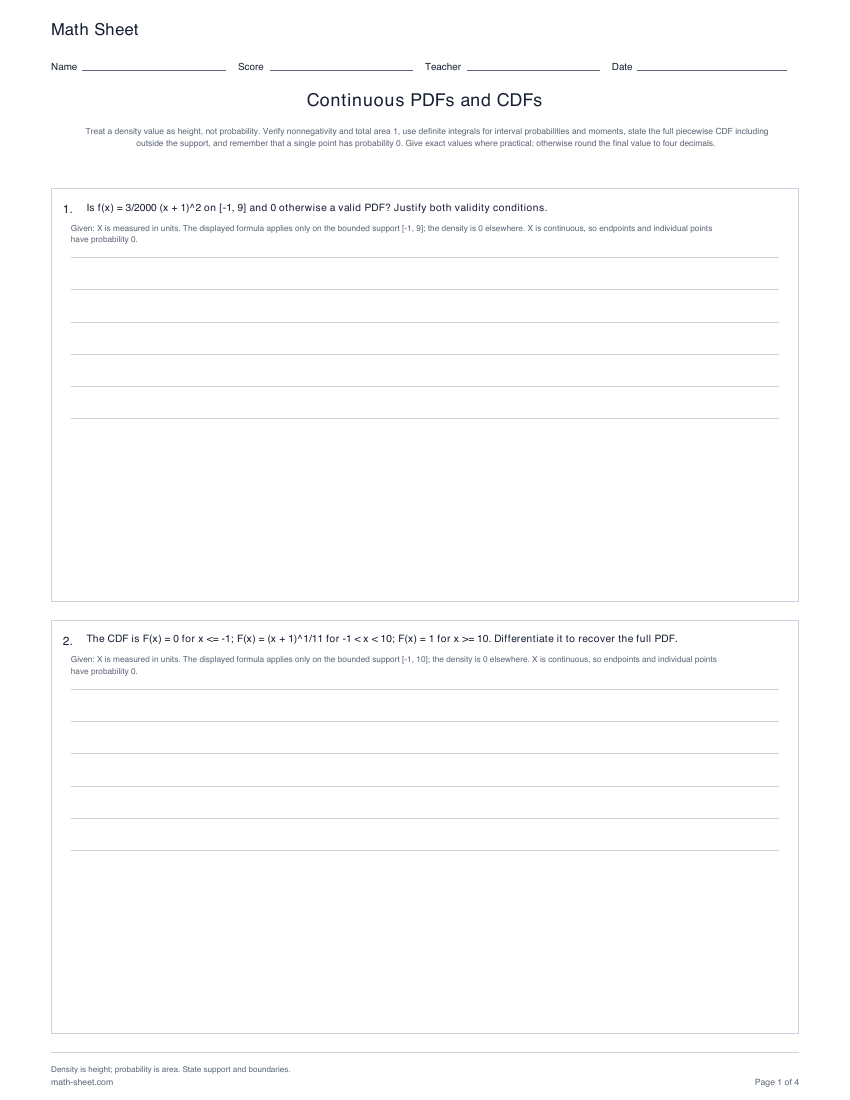
Math SheetNameScoreTeacherDateContinuous PDFs and CDFsTreat a density value as height, not probability. Verify nonnegativity and total area 1, use definite integrals for interval probabilities and moments, state the full piecewise CDF includingoutside the support, and remember that a single point has probability 0. Give exact values where practical; otherwise round the final value to four decimals.1.Is f(x) = 3/2000 (x + 1)^2 on [-1, 9] and 0 otherwise a valid PDF? Justify both validity conditions.Given: X is measured in units. The displayed formula applies only on the bounded support [-1, 9]; the density is 0 elsewhere. X is continuous, so endpoints and individual pointshave probability 0.2.The CDF is F(x) = 0 for x <= -1; F(x) = (x + 1)^1/11 for -1 < x < 10; F(x) = 1 for x >= 10. Differentiate it to recover the full PDF.Given: X is measured in units. The displayed formula applies only on the bounded support [-1, 10]; the density is 0 elsewhere. X is continuous, so endpoints and individual pointshave probability 0.Density is height; probability is area. State support and boundaries.math-sheet.comPage 1 of 4
Math SheetNameScoreTeacherDateContinuous PDFs and CDFsTreat a density value as height, not probability. Verify nonnegativity and total area 1, use definite integrals for interval probabilities and moments, state the full piecewise CDF includingoutside the support, and remember that a single point has probability 0. Give exact values where practical; otherwise round the final value to four decimals.3.For the PDF f(x) = 1/8 (x - 2) on [2, 6], find E(X).Given: X is measured in units. The displayed formula applies only on the bounded support [2, 6]; the density is 0 elsewhere. X is continuous, so endpoints and individual pointshave probability 0.4.For f(x) = 1/10 on [-3, 7] and 0 otherwise, derive the full piecewise CDF F(x), including both outside-support branches.Given: X is measured in units. The displayed formula applies only on the bounded support [-3, 7]; the density is 0 elsewhere. X is continuous, so endpoints and individual pointshave probability 0.Density is height; probability is area. State support and boundaries.math-sheet.comPage 2 of 4
Math SheetNameScoreTeacherDateContinuous PDFs and CDFsTreat a density value as height, not probability. Verify nonnegativity and total area 1, use definite integrals for interval probabilities and moments, state the full piecewise CDF includingoutside the support, and remember that a single point has probability 0. Give exact values where practical; otherwise round the final value to four decimals.5.For f(x) = 2/121 (x - 3) on [3, 14] and 0 otherwise, find P(3 <= X <= 13).Given: X is measured in units. The displayed formula applies only on the bounded support [3, 14]; the density is 0 elsewhere. X is continuous, so endpoints and individual pointshave probability 0.6.On -2 <= x <= 8, let f(x) = k (x + 2)^2, and let f(x) = 0 otherwise. Find k so f is a valid PDF.Given: X is measured in units. The displayed formula applies only on the bounded support [-2, 8]; the density is 0 elsewhere. X is continuous, so endpoints and individual pointshave probability 0.Density is height; probability is area. State support and boundaries.math-sheet.comPage 3 of 4
Math SheetNameScoreTeacherDateContinuous PDFs and CDFsTreat a density value as height, not probability. Verify nonnegativity and total area 1, use definite integrals for interval probabilities and moments, state the full piecewise CDF includingoutside the support, and remember that a single point has probability 0. Give exact values where practical; otherwise round the final value to four decimals.7.For the continuous PDF f(x) = 3/64 (x + 1)^2 on [-1, 3], find P(X = 3).Given: X is measured in units. The displayed formula applies only on the bounded support [-1, 3]; the density is 0 elsewhere. X is continuous, so endpoints and individual pointshave probability 0.8.For the PDF f(x) = 1/2 on [0, 2], find Var(X).Given: X is measured in units. The displayed formula applies only on the bounded support [0, 2]; the density is 0 elsewhere. X is continuous, so endpoints and individual pointshave probability 0.Density is height; probability is area. State support and boundaries.math-sheet.comPage 4 of 4

A useful next step

Related activities

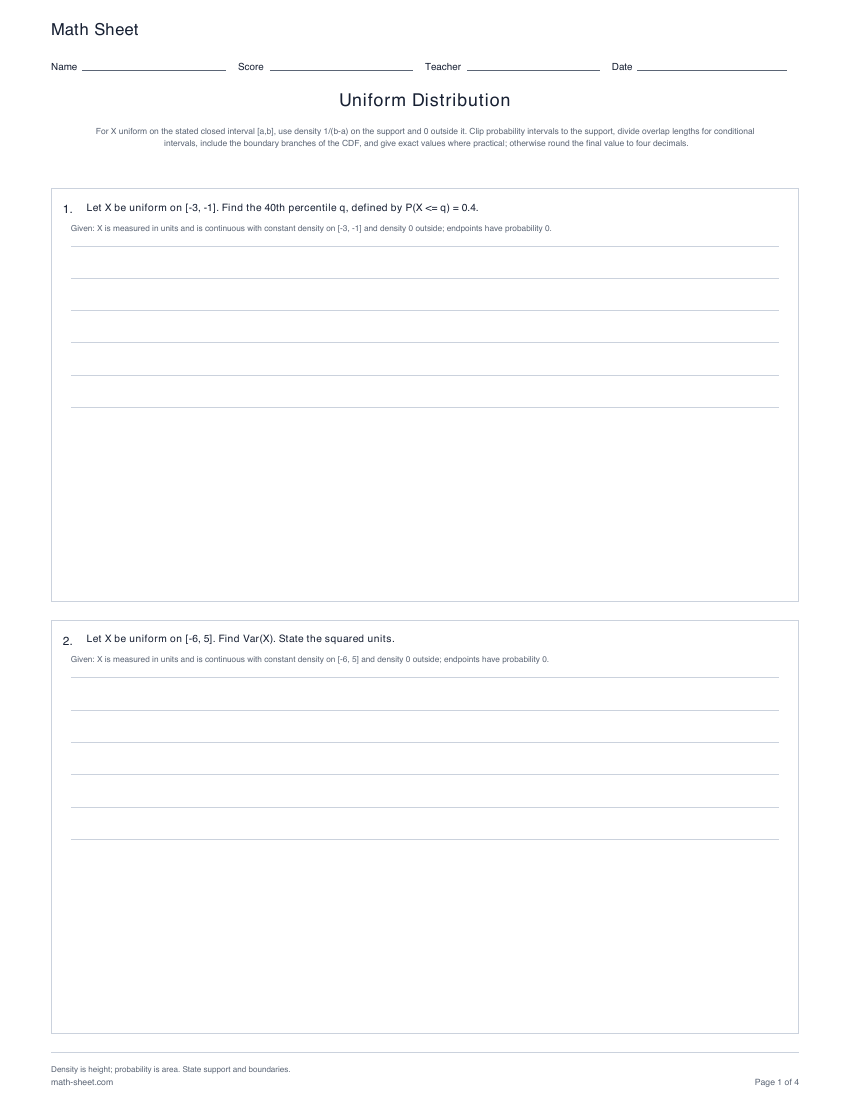
Printable uniform distribution worksheets preview

Probability

Uniform Distribution worksheets

Use support length for density, clipped interval and conditional probabilities, piecewise CDFs, quantiles, mean, and variance.

Preview and download