Probability practice

Compound Counting and Probability worksheets

Reconstruct two- and three-set totals, count compound outcomes, and calculate collision probabilities by complements.

Ready-made English PDF · fixed settings

Customization below makes a separate PDF.

Fixed English ready-made files. Custom settings below apply only to the configured PDF.

Ready to print

Start with a ready-made worksheet

Show favorable and total counts before forming a probability. For collisions, use the no-collision complement.

Download the practice pages alone, or include a separate answer key or teacher model. Longer activities may use more than one page.

Customize this worksheet

Paper sizes and printing help · More probability activities

Make the mathematical structure visible

Each problem prints the support, table, model assumptions, or sample convention needed to solve it on paper. Student pages reserve workspace; teacher downloads append a separate worked key generated from the same validated document.

Learning objective

What this activity builds

Translate overlapping sets and multistage selections into correct favorable and total counts before forming a probability.

Worked example

From 10 labels, three draws are made with replacement. Find the chance of a match.

1-(10/10)(9/10)(8/10)=0.28.

The complement has all three labels distinct.

Teaching notes

Make the practice count

  • Draw atomic regions before using inclusion-exclusion.
  • Keep favorable and total counts separate.
  • Use a complement for at least one collision.

Make it yours

Customize the practice

Choose your options, update the preview, then download the exact same pages.

Choose one or more bounded question types, problem count, paper size, and seed.

Worksheet settings

Question types
Page note and reproducible seed

The same settings and seed make the same questions. Shared links include your page note; leave personal information out.

Configured PDF · Compound Counting and Probability · US Letter

Preview ready. Download includes these exact pages.

4 student pages
Enlarged pages scroll. PDF size stays the same.
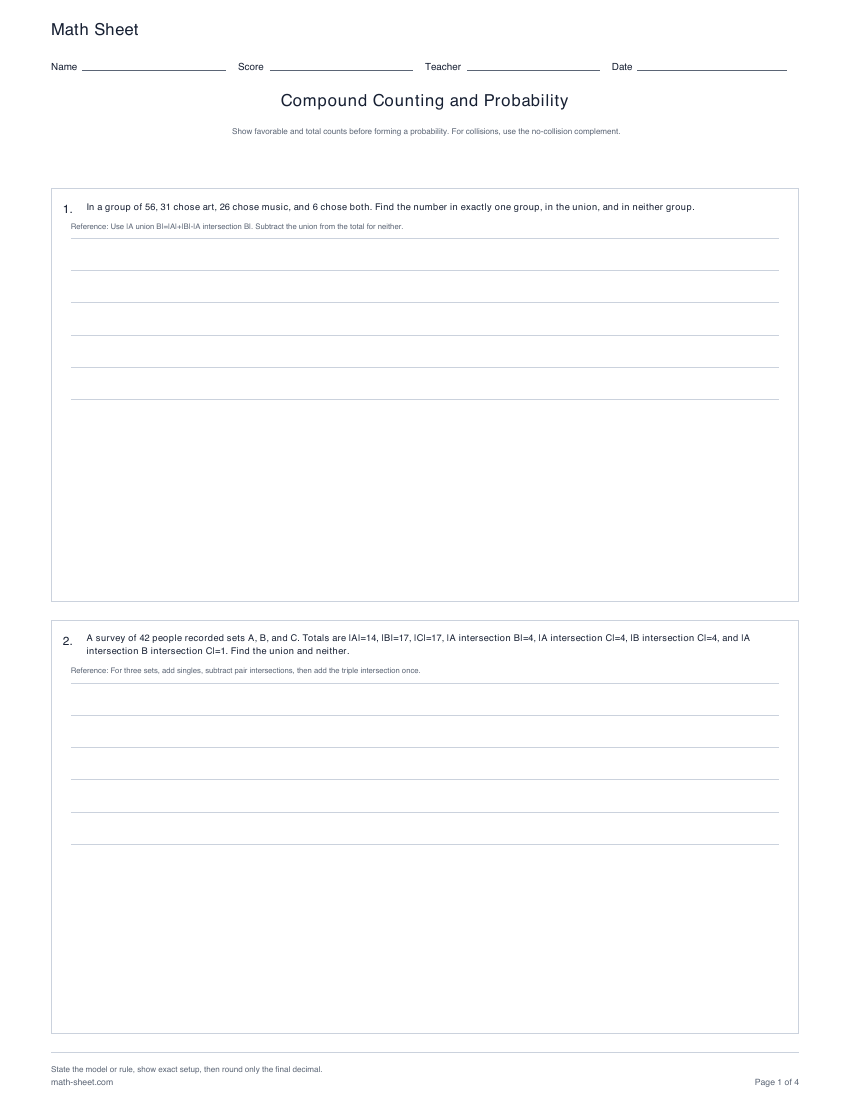
Math SheetNameScoreTeacherDateCompound Counting and ProbabilityShow favorable and total counts before forming a probability. For collisions, use the no-collision complement.1.In a group of 56, 31 chose art, 26 chose music, and 6 chose both. Find the number in exactly one group, in the union, and in neither group.Reference: Use |A union B|=|A|+|B|-|A intersection B|. Subtract the union from the total for neither.2.A survey of 42 people recorded sets A, B, and C. Totals are |A|=14, |B|=17, |C|=17, |A intersection B|=4, |A intersection C|=4, |B intersection C|=4, and |Aintersection B intersection C|=1. Find the union and neither.Reference: For three sets, add singles, subtract pair intersections, then add the triple intersection once.State the model or rule, show exact setup, then round only the final decimal.math-sheet.comPage 1 of 4
Math SheetNameScoreTeacherDateCompound Counting and ProbabilityShow favorable and total counts before forming a probability. For collisions, use the no-collision complement.3.4 selections are made independently and uniformly from 15 labels, with replacement. Find the probability that at least two selections match.Reference: Compute 1 minus the probability that all selections are distinct.4.A code uses one of 8 colors followed by one of 10 digits, with every code equally likely. A prize code uses one of 4 marked colors and one of 8 marked digits.Find the favorable count, total count, and probability.Reference: Use the multiplication rule separately for favorable outcomes and for all outcomes.State the model or rule, show exact setup, then round only the final decimal.math-sheet.comPage 2 of 4
Math SheetNameScoreTeacherDateCompound Counting and ProbabilityShow favorable and total counts before forming a probability. For collisions, use the no-collision complement.5.6 selections are made independently and uniformly from 19 labels, with replacement. Find the probability that at least two selections match.Reference: Compute 1 minus the probability that all selections are distinct.6.A survey of 41 people recorded sets A, B, and C. Totals are |A|=14, |B|=16, |C|=15, |A intersection B|=5, |A intersection C|=5, |B intersection C|=5, and |Aintersection B intersection C|=2. Find the union and neither.Reference: For three sets, add singles, subtract pair intersections, then add the triple intersection once.State the model or rule, show exact setup, then round only the final decimal.math-sheet.comPage 3 of 4
Math SheetNameScoreTeacherDateCompound Counting and ProbabilityShow favorable and total counts before forming a probability. For collisions, use the no-collision complement.7.A code uses one of 6 colors followed by one of 10 digits, with every code equally likely. A prize code uses one of 2 marked colors and one of 3 marked digits.Find the favorable count, total count, and probability.Reference: Use the multiplication rule separately for favorable outcomes and for all outcomes.8.In a group of 54, 28 chose art, 28 chose music, and 6 chose both. Find the number in exactly one group, in the union, and in neither group.Reference: Use |A union B|=|A|+|B|-|A intersection B|. Subtract the union from the total for neither.State the model or rule, show exact setup, then round only the final decimal.math-sheet.comPage 4 of 4

A useful next step

Related activities