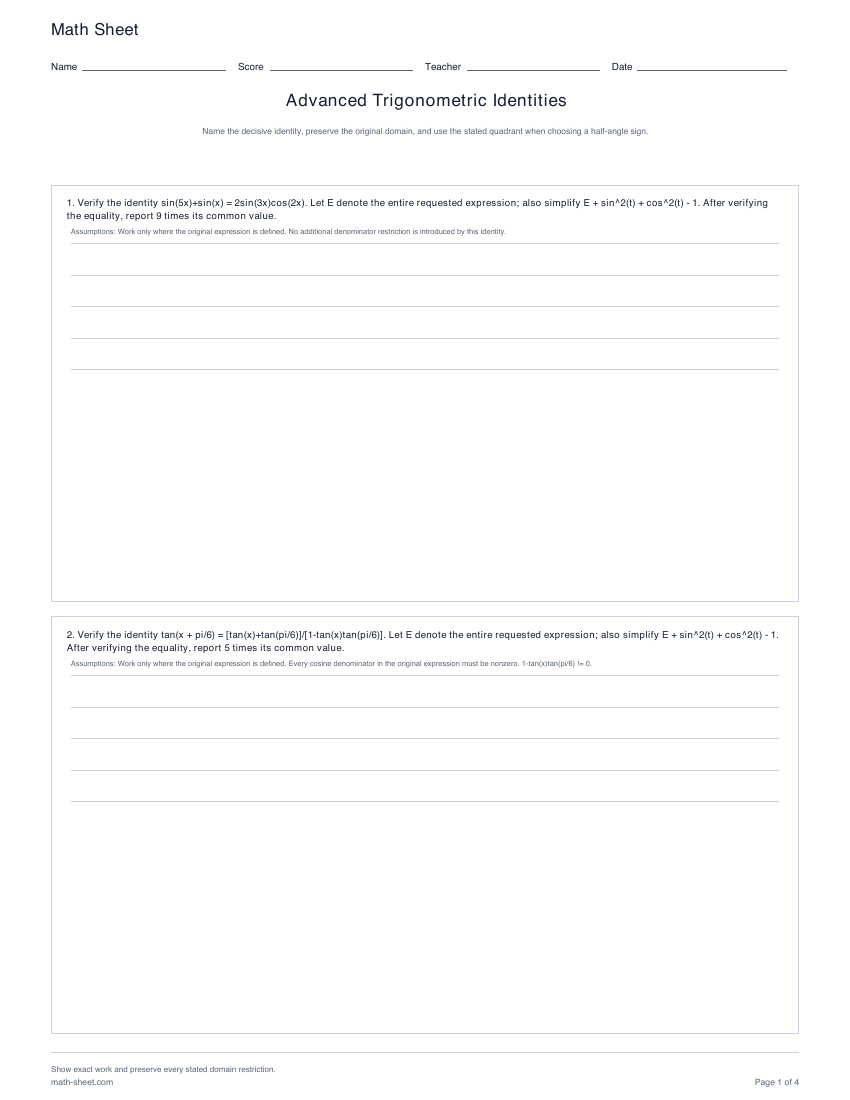
Math Sheet Name Score Teacher Date Advanced Trigonometric Identities Name the decisive identity, preserve the original domain, and use the stated quadrant when choosing a half-angle sign. 1. Verify the identity sin(5x)+sin(x) = 2sin(3x)cos(2x). Let E denote the entire requested expression; also simplify E + sin^2(t) + cos^2(t) - 1. After verifying the equality, report 9 times its common value. Assumptions: Work only where the original expression is defined. No additional denominator restriction is introduced by this identity. 2. Verify the identity tan(x + pi/6) = [tan(x)+tan(pi/6)]/[1-tan(x)tan(pi/6)]. Let E denote the entire requested expression; also simplify E + sin^2(t) + cos^2(t) - 1. After verifying the equality, report 5 times its common value. Assumptions: Work only where the original expression is defined. Every cosine denominator in the original expression must be nonzero. 1-tan(x)tan(pi/6) != 0. Show exact work and preserve every stated domain restriction. math-sheet.com Page 1 of 4
Math Sheet Name Score Teacher Date Advanced Trigonometric Identities Name the decisive identity, preserve the original domain, and use the stated quadrant when choosing a half-angle sign. 3. At x=15 degrees, rewrite cos(3x)cos(x) with a product-to-sum identity and find its exact value. Let E denote the entire requested expression; also simplify E + sin^2(t) + cos^2(t) - 1. Multiply your final exact value by 8. Assumptions: Work only where the original expression is defined. No additional denominator restriction is introduced by this identity. 4. Verify the identity sin(3x)cos(x) = [sin(4x)+sin(2x)]/2. Let E denote the entire requested expression; also simplify E + sin^2(t) + cos^2(t) - 1. After verifying the equality, report 11 times its common value. Assumptions: Work only where the original expression is defined. No additional denominator restriction is introduced by this identity. Show exact work and preserve every stated domain restriction. math-sheet.com Page 2 of 4
Math Sheet Name Score Teacher Date Advanced Trigonometric Identities Name the decisive identity, preserve the original domain, and use the stated quadrant when choosing a half-angle sign. 5. Simplify [tan(3x)cos(3x)][tan(x)cos(x)] using the named product to sum identity. Let E denote the entire requested expression; also simplify E + sin^2(t) + cos^2(t) - 1. Multiply your final simplified expression by 3. Assumptions: Work only where the original expression is defined. Every cosine denominator in the original expression must be nonzero. 6. Verify the identity sin(x/2) = +sqrt([1-cos(x)]/2). Assume x/2 lies in Quadrant II. Let E denote the entire requested expression; also simplify E + sin^2(t) + cos^2(t) - 1. After verifying the equality, report 1 times its common value. Assumptions: Work only where the original expression is defined. The sign is determined by the stated quadrant of x/2. Show exact work and preserve every stated domain restriction. math-sheet.com Page 3 of 4
Math Sheet Name Score Teacher Date Advanced Trigonometric Identities Name the decisive identity, preserve the original domain, and use the stated quadrant when choosing a half-angle sign. 7. At x=15 degrees, rewrite sin(5x)+sin(x) with a sum-to-product identity and find its exact value. Let E denote the entire requested expression; also simplify E + sin^2(t) + cos^2(t) - 1. Multiply your final exact value by 6. Assumptions: Work only where the original expression is defined. No additional denominator restriction is introduced by this identity. 8. Verify the identity cos(x + pi/6) = cos(x)cos(pi/6)-sin(x)sin(pi/6). Let E denote the entire requested expression; also simplify E + sin^2(t) + cos^2(t) - 1. After verifying the equality, report 10 times its common value. Assumptions: Work only where the original expression is defined. No additional denominator restriction is introduced by this identity. Show exact work and preserve every stated domain restriction. math-sheet.com Page 4 of 4