
Polynomials
Descartes Rule of Signs worksheets
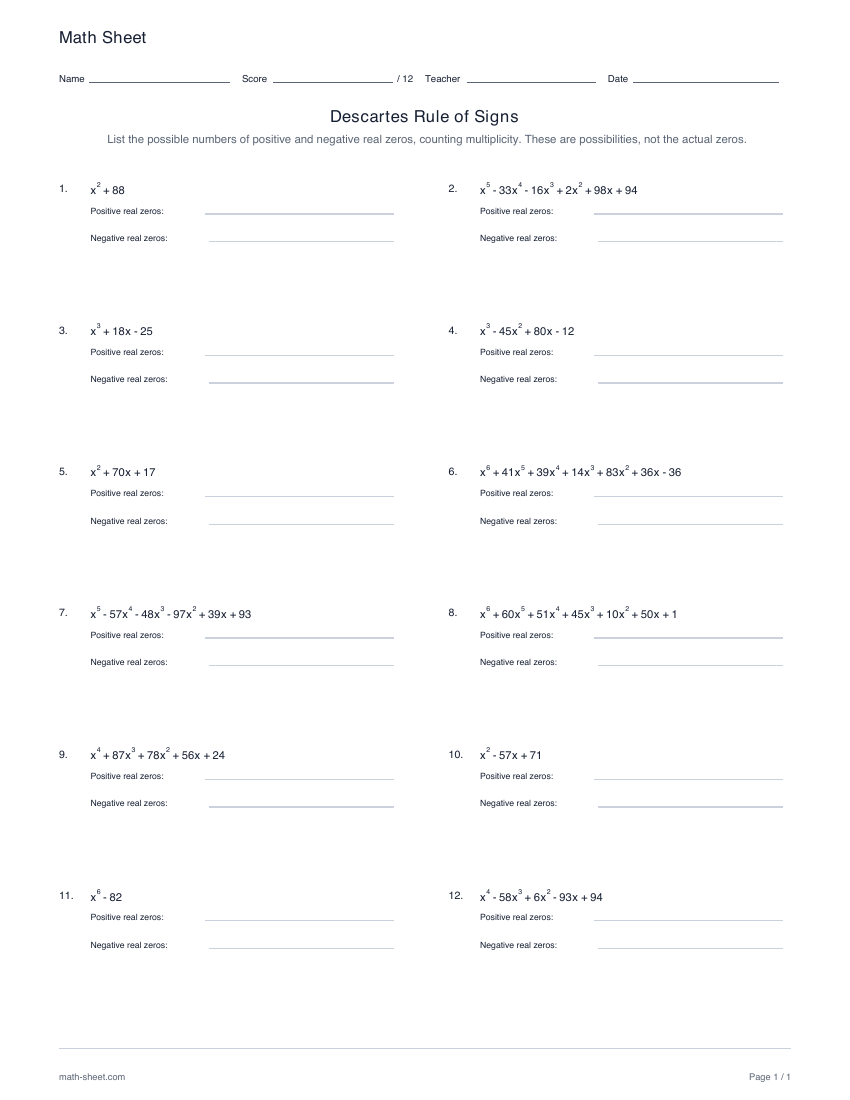
Use sign changes in P(x) and P(−x) to list every possible number of positive and negative real zeros for twelve degree-two through degree-six polynomials.
Preview and downloadPolynomials practice
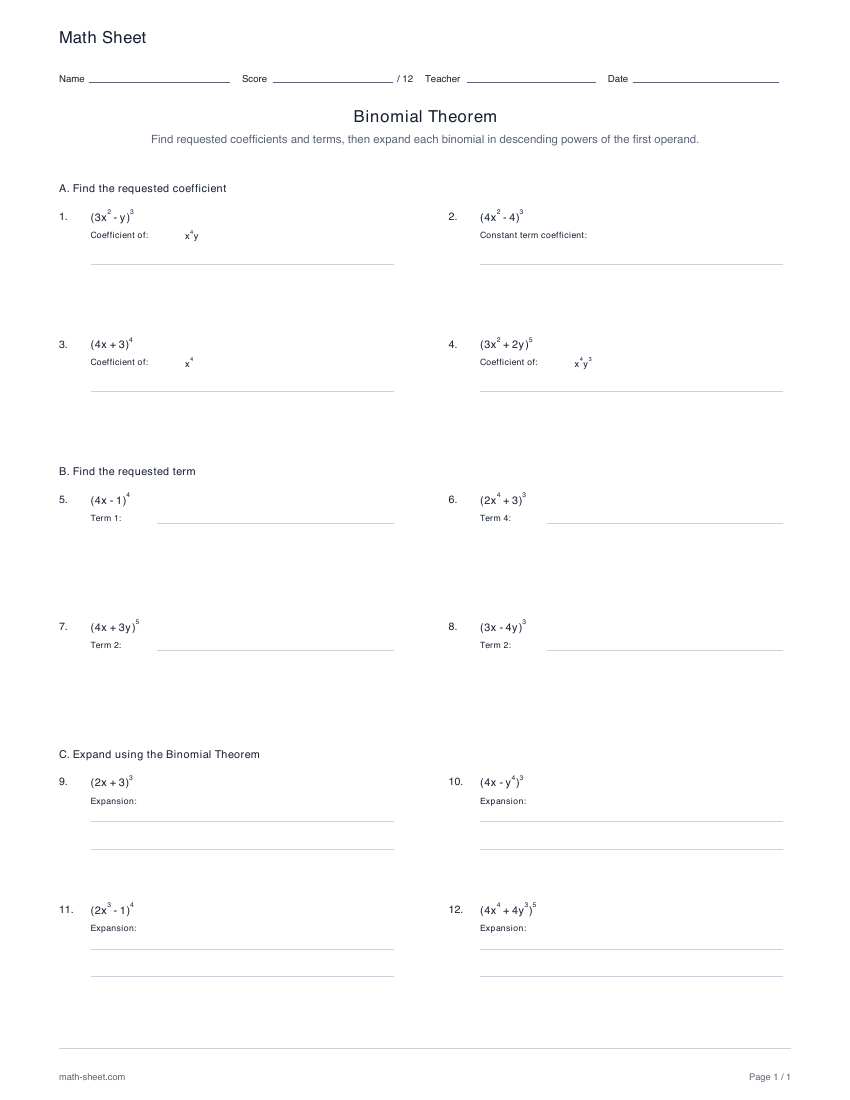
Find exact coefficients, identify requested ordinal terms, and write complete ordered expansions for twelve one-variable, two-variable, linear, higher-power, and hybrid binomials.
Ready-made English PDF · fixed settings
Customization below makes a separate PDF.
Fixed English ready-made files. Custom settings below apply only to the configured PDF.
Ready to print
Find requested coefficients and terms, then expand each binomial in descending powers of the first operand.
Download the practice pages alone, or include a separate answer key or teacher model. Longer activities may use more than one page.
Customize this worksheetKeep the printed operands in order. The (k + 1)th term is C(n,k) times the first operand to n − k times the second operand to k.
Ordinal terms follow descending powers of the first operand, even when the second variable has higher total degree. A complete expansion has n + 1 exact signed terms.
Learning objective
Use T_(k+1) = C(n,k) first^(n−k) second^k while preserving the ordered operands and every signed term.
Worked example
24x²y⁴.
The third term uses k = 2: C(4,2)(2x)²(−y²)² = 6 · 4x² · y⁴.
Teaching notes
Make it yours
Choose your options, update the preview, then download the exact same pages.
Choose one or two variables and linear or higher powers. Each sheet asks for four coefficients, four ordinal terms, and four complete expansions.
A useful next step
Polynomials
Use sign changes in P(x) and P(−x) to list every possible number of positive and negative real zeros for twelve degree-two through degree-six polynomials.
Preview and download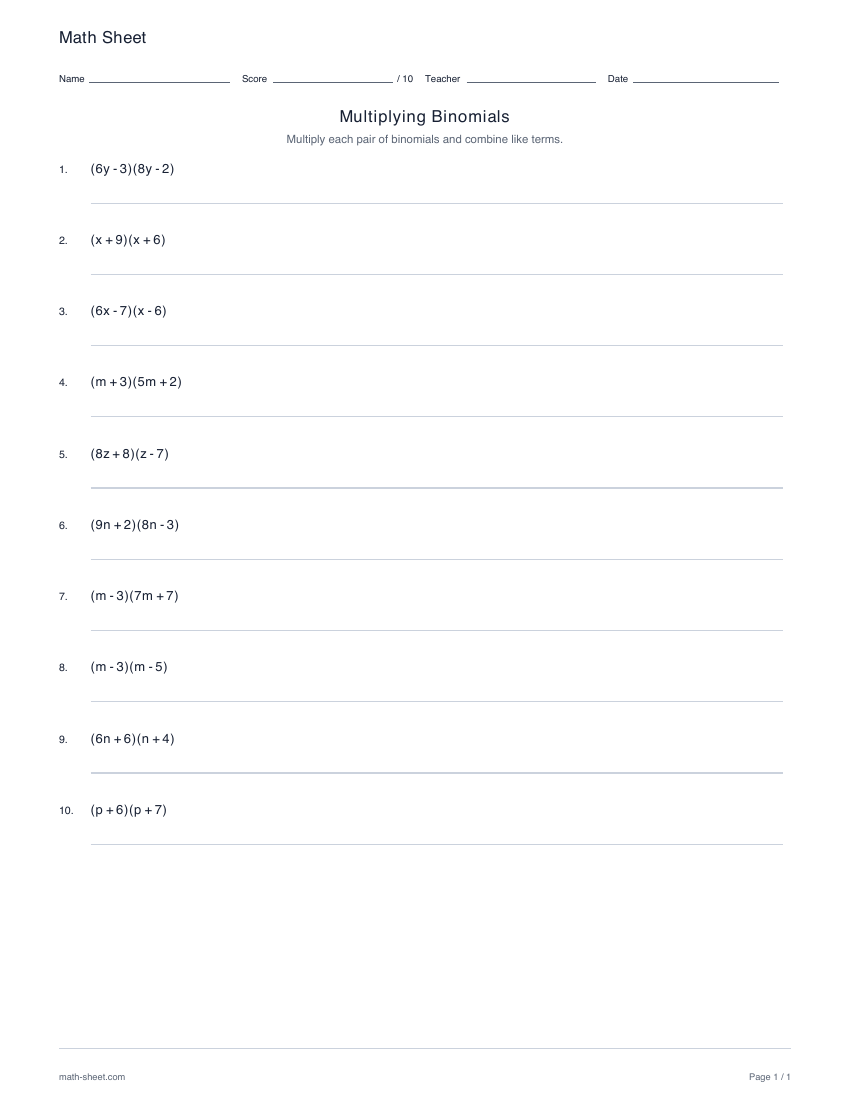
Polynomials
Expand ten products of two binomials. Choose among four expression structures, form every term pair and collect like terms with a separate worked key.
Preview and download