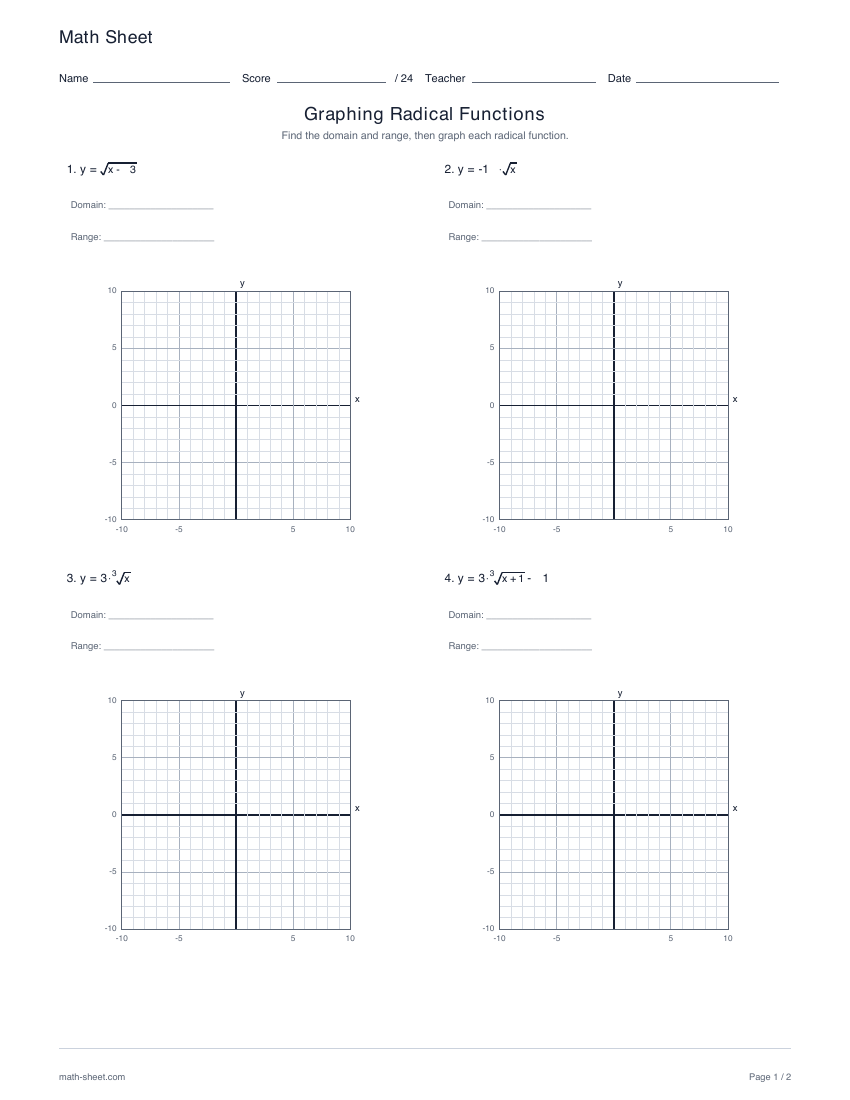
Find the domain and range, then graph eight transformed square-root and cube-root functions on unit grids. Choose square roots, cube roots or balanced mixed practice with separate completed graph keys.
Each worksheet contains eight direct radical functions. Mixed practice gives four square roots and four cube roots; focused modes retain positive and negative coefficients, shifts and nonunit stretches.
For y = a root_n(x - h) + k, use t as the root value: x = h + t^n and y = k + at. Square roots use t >= 0 and begin at the included endpoint (h, k). Cube roots use every real t and pass through the center (h, k).
The separate key states the global domain and range, marks exact on-grid points and draws only the visible part of the continuing curve. Grid boundaries never become fake domain endpoints.
Learning objective
What this activity builds
Use an endpoint or center and exact transformed points to graph square-root and cube-root functions with their global domains and ranges.
Worked example
Graph y = -2√(x - 1) + 3.
Endpoint (1, 3); domain x >= 1; range y <= 3. Useful points include (2, 1) and (5, -1).
The radicand starts at zero when x = 1. The negative coefficient reflects the parent square-root graph downward, and its magnitude doubles each vertical change.
Teaching notes
Make the practice count
Set x - h equal to zero to find the square-root endpoint.
Use t = 0, 1, 2 for square roots and t = -2, -1, 0, 1, 2 for cube roots.
Apply the outside coefficient and vertical shift to each t-value.
Keep domain and range global even though the grid shows only -10 to 10.
Use arrows at grid edges to show that the function continues.
Make it yours
Customize the practice
Choose your options, update the preview, then download the exact same pages.
Choose square roots, cube roots or balanced mixed practice. Each sheet has eight distinct transformed functions, global domain and range prompts, and four graphs per page.
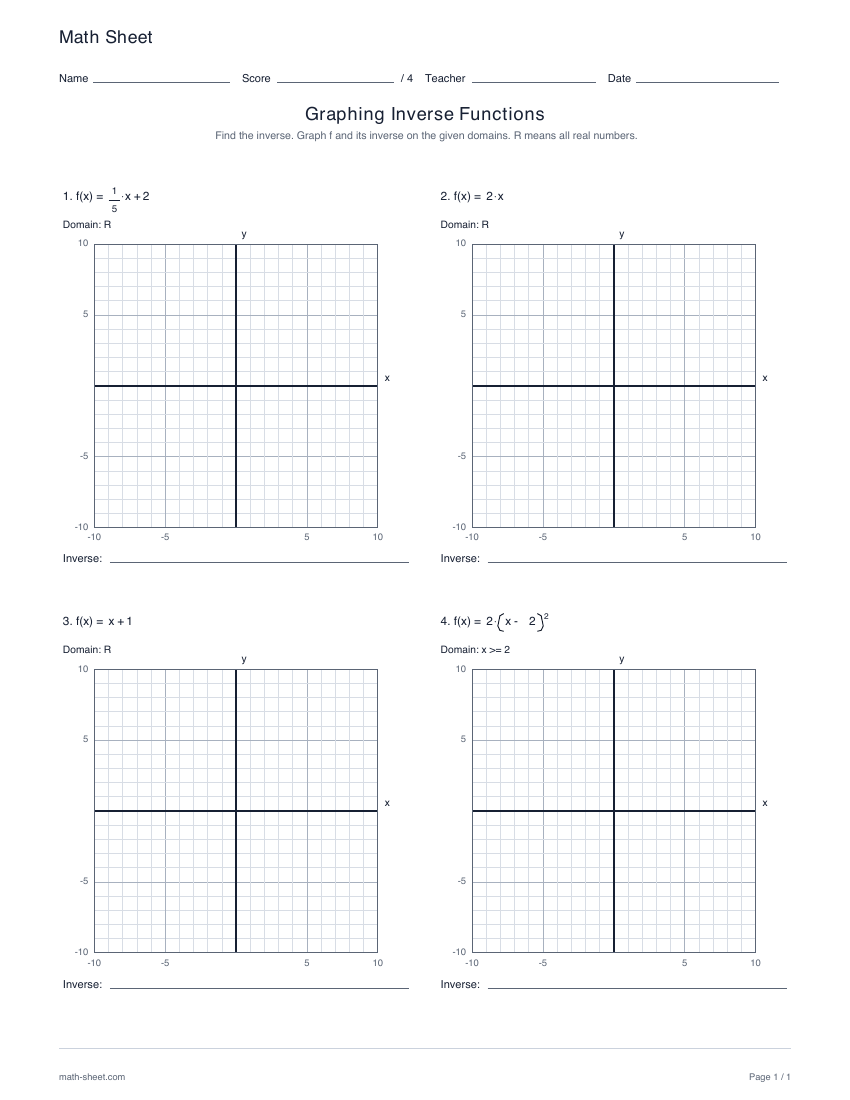
Find and graph four inverse functions. Choose fractional or integer linear rules, lines through the origin, quadratic branches and cubic functions, with completed graph keys.
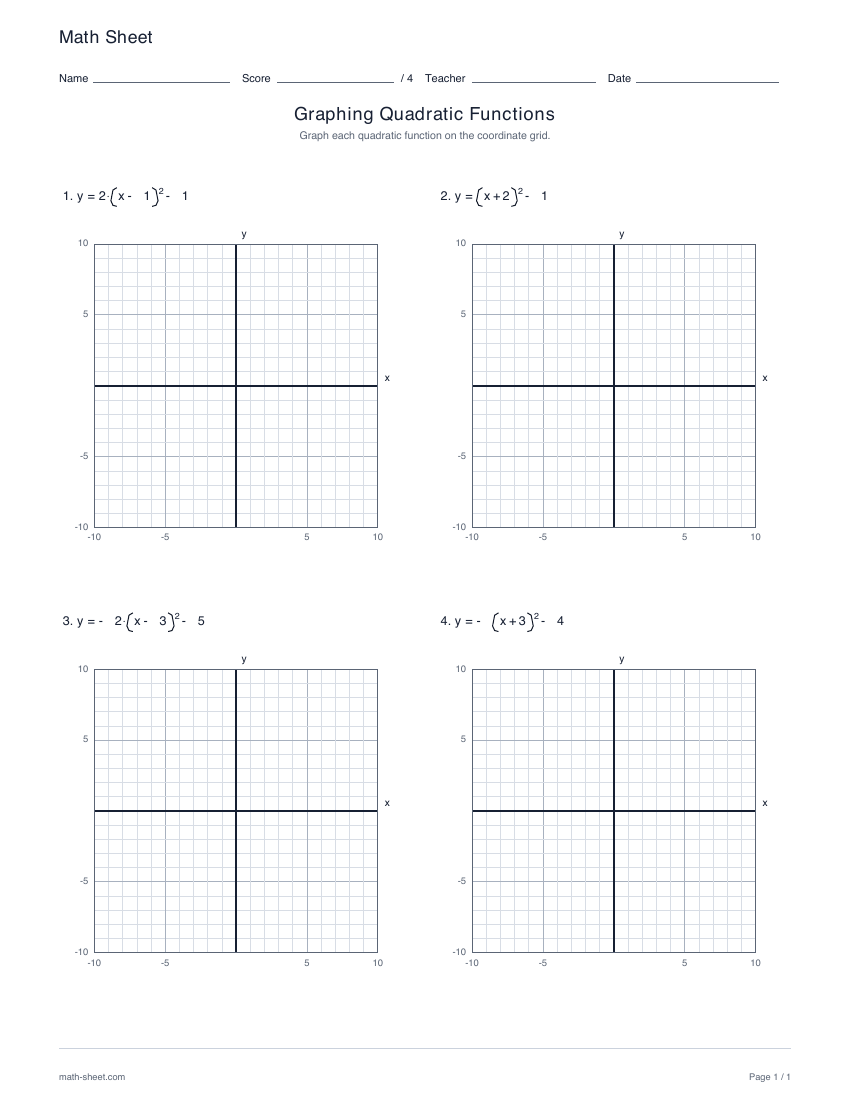
Graph four quadratic functions in vertex form on blank coordinate grids. Each sheet includes every leading coefficient from −2, −1, 1 and 2, with a separate completed graph key.
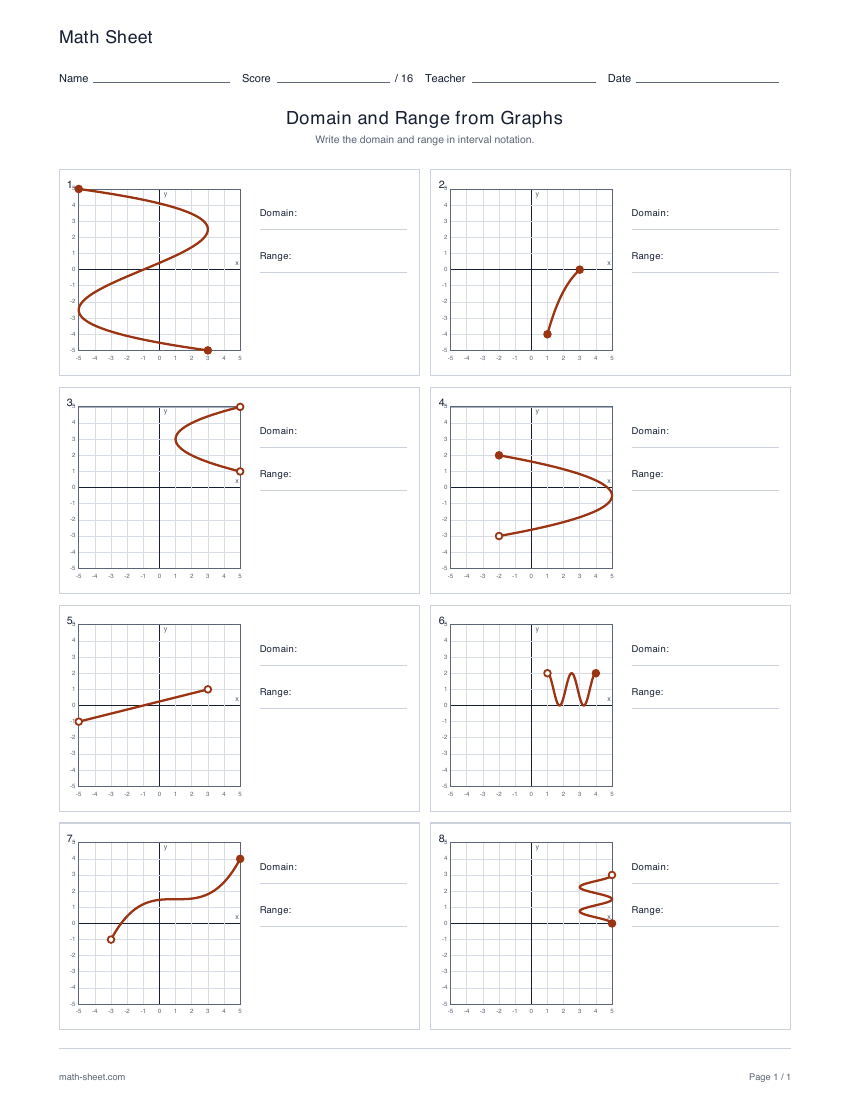
Read finite domain and range intervals from eight varied relation graphs. Practice open and closed extrema and optionally apply the vertical line test.