Calculus II practice

Taylor Series Approximations and Error worksheets

Represent standard functions, approximate nearby values, and apply alternating or Lagrange error bounds.

Ready-made English PDF · fixed settings

Customization below makes a separate PDF.

Fixed English ready-made files. Custom settings below apply only to the configured PDF.

Ready to print

Start with a ready-made worksheet

Represent standard functions, approximate nearby values, and apply alternating or Lagrange error bounds.

Download the practice pages alone, or include a separate answer key or teacher model. Longer activities may use more than one page.

Customize this worksheet

Paper sizes and printing help · More calculus ii activities

Conclusions are tied to visible reasoning

Generated keys distinguish sequence limits, partial sums, infinite-series convergence, endpoint behavior, and approximation error instead of collapsing them into a single answer.

Learning objective

What this activity builds

Separate the exact function value, polynomial approximation, actual error, and proven bound.

Worked example

What belongs in a complete solution?

The governing limit or test, its hypotheses, the calculation, and a precise conclusion.

The worked key preserves the reasoning that distinguishes similar-looking sequence and series tasks.

Teaching notes

Make the practice count

  • Have students name the mathematical object before choosing a method.
  • Require separate endpoint checks for power series.
  • Keep exact values and labeled approximations side by side.

Make it yours

Customize the practice

Choose your options, update the preview, then download the exact same pages.

Choose task families and conclusions. Keep the seed to reproduce the same printed givens and worked key.

Worksheet settings

Functions
Centers
Tasks
Error methods
Page note and reproducible seed

The same settings and seed make the same questions. Shared links include your page note; leave personal information out.

Configured PDF · Taylor Series Approximations and Error · US Letter

Preview ready. Download includes these exact pages.

3 student pages
Enlarged pages scroll. PDF size stays the same.
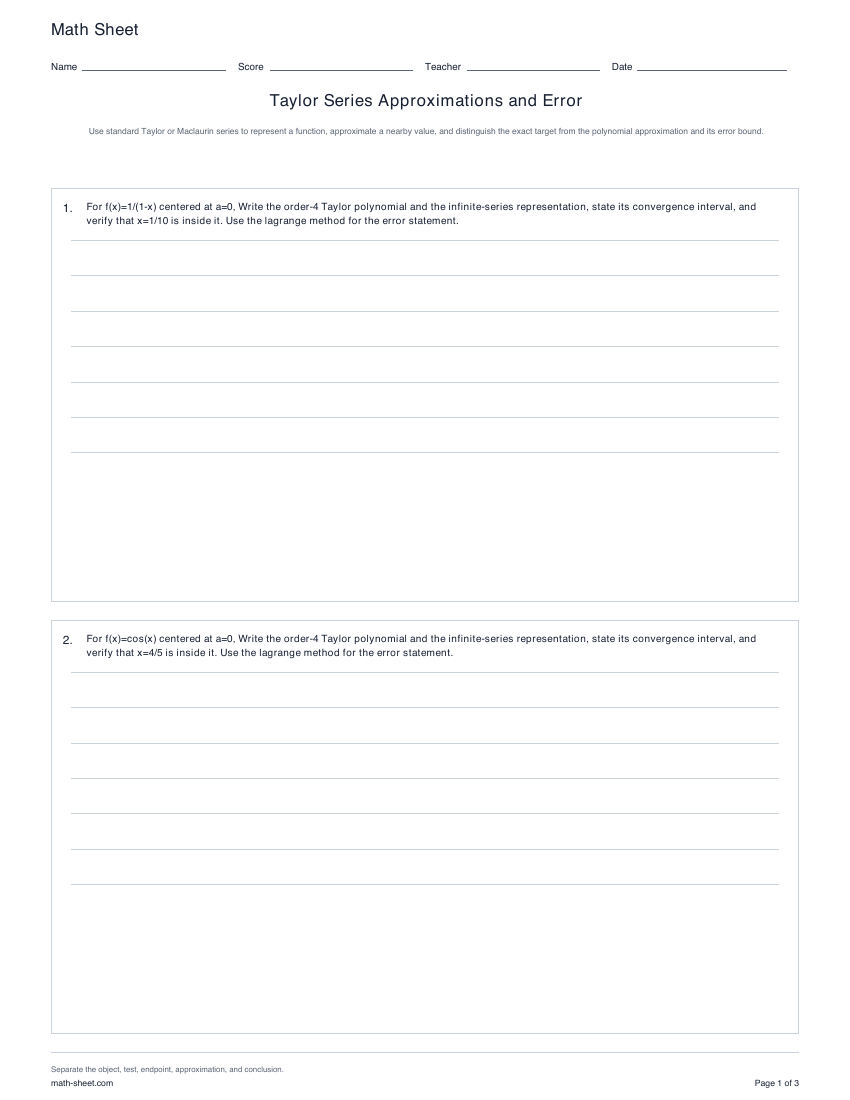
Math SheetNameScoreTeacherDateTaylor Series Approximations and ErrorUse standard Taylor or Maclaurin series to represent a function, approximate a nearby value, and distinguish the exact target from the polynomial approximation and its error bound.1.For f(x)=1/(1-x) centered at a=0, Write the order-4 Taylor polynomial and the infinite-series representation, state its convergence interval, andverify that x=1/10 is inside it. Use the lagrange method for the error statement.2.For f(x)=cos(x) centered at a=0, Write the order-4 Taylor polynomial and the infinite-series representation, state its convergence interval, andverify that x=4/5 is inside it. Use the lagrange method for the error statement.Separate the object, test, endpoint, approximation, and conclusion.math-sheet.comPage 1 of 3
Math SheetNameScoreTeacherDateTaylor Series Approximations and ErrorUse standard Taylor or Maclaurin series to represent a function, approximate a nearby value, and distinguish the exact target from the polynomial approximation and its error bound.3.For f(x)=ln(1+x) centered at a=0, Use the lagrange remainder method to bound the error at the exact point x=2/5. Use the lagrange method for theerror statement.4.For f(x)=e^x centered at a=0, Write the order-4 Taylor polynomial and the infinite-series representation, state its convergence interval, and verifythat x=9/20 is inside it. Use the lagrange method for the error statement.Separate the object, test, endpoint, approximation, and conclusion.math-sheet.comPage 2 of 3
Math SheetNameScoreTeacherDateTaylor Series Approximations and ErrorUse standard Taylor or Maclaurin series to represent a function, approximate a nearby value, and distinguish the exact target from the polynomial approximation and its error bound.5.For f(x)=cos(x) centered at a=0, Use the order-4 polynomial to approximate the exact target f(2/5)=cos(2/5). Use the alternating method for theerror statement.6.For f(x)=sin(x) centered at a=0, Use the lagrange remainder method to bound the error at the exact point x=2/5. Use the lagrange method for theerror statement.Separate the object, test, endpoint, approximation, and conclusion.math-sheet.comPage 3 of 3

A useful next step

Related activities