Calculus II practice

Power Series Intervals of Convergence worksheets

Find radii and intervals, test both endpoints separately, and track endpoint changes under termwise operations.

Ready-made English PDF · fixed settings

Customization below makes a separate PDF.

Fixed English ready-made files. Custom settings below apply only to the configured PDF.

Ready to print

Start with a ready-made worksheet

Find radii and intervals, test both endpoints separately, and track endpoint changes under termwise operations.

Download the practice pages alone, or include a separate answer key or teacher model. Longer activities may use more than one page.

Customize this worksheet

Paper sizes and printing help · More calculus ii activities

Conclusions are tied to visible reasoning

Generated keys distinguish sequence limits, partial sums, infinite-series convergence, endpoint behavior, and approximation error instead of collapsing them into a single answer.

Learning objective

What this activity builds

Determine the radius and verify each endpoint rather than inferring brackets from the radius.

Worked example

What belongs in a complete solution?

The governing limit or test, its hypotheses, the calculation, and a precise conclusion.

The worked key preserves the reasoning that distinguishes similar-looking sequence and series tasks.

Teaching notes

Make the practice count

  • Have students name the mathematical object before choosing a method.
  • Require separate endpoint checks for power series.
  • Keep exact values and labeled approximations side by side.

Make it yours

Customize the practice

Choose your options, update the preview, then download the exact same pages.

Choose task families and conclusions. Keep the seed to reproduce the same printed givens and worked key.

Worksheet settings

Centers
Operation
Endpoint results
Page note and reproducible seed

The same settings and seed make the same questions. Shared links include your page note; leave personal information out.

Configured PDF · Power Series Radius and Interval of Convergence · US Letter

Preview ready. Download includes these exact pages.

3 student pages
Enlarged pages scroll. PDF size stays the same.
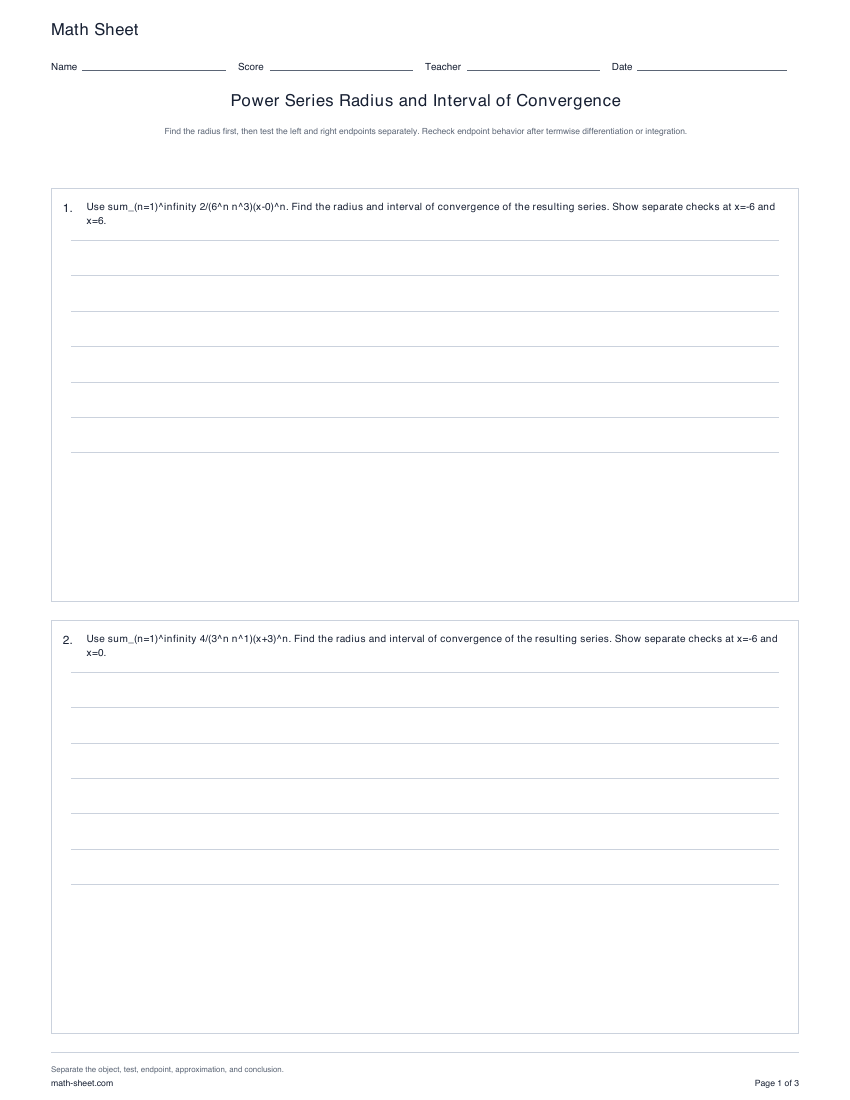
Math SheetNameScoreTeacherDatePower Series Radius and Interval of ConvergenceFind the radius first, then test the left and right endpoints separately. Recheck endpoint behavior after termwise differentiation or integration.1.Use sum_(n=1)^infinity 2/(6^n n^3)(x-0)^n. Find the radius and interval of convergence of the resulting series. Show separate checks at x=-6 andx=6.2.Use sum_(n=1)^infinity 4/(3^n n^1)(x+3)^n. Find the radius and interval of convergence of the resulting series. Show separate checks at x=-6 andx=0.Separate the object, test, endpoint, approximation, and conclusion.math-sheet.comPage 1 of 3
Math SheetNameScoreTeacherDatePower Series Radius and Interval of ConvergenceFind the radius first, then test the left and right endpoints separately. Recheck endpoint behavior after termwise differentiation or integration.3.Integrate sum_(n=1)^infinity 5/(2^n n^1)(x+3)^n term by term with constant C=0 to obtain sum_(n=1)^infinity 5(x+3)^(n+1)/[2^n n^1(n+1)]. Find theradius and interval of convergence of the resulting series. Show separate checks at x=-5 and x=-1.4.Use sum_(n=1)^infinity 4/6^n(x-1)^n. Find the radius and interval of convergence of the resulting series. Show separate checks at x=-5 and x=7.Separate the object, test, endpoint, approximation, and conclusion.math-sheet.comPage 2 of 3
Math SheetNameScoreTeacherDatePower Series Radius and Interval of ConvergenceFind the radius first, then test the left and right endpoints separately. Recheck endpoint behavior after termwise differentiation or integration.5.Differentiate sum_(n=1)^infinity 5/(7^n n^2)(x-2)^n term by term to obtain sum_(n=1)^infinity 5n(x-2)^(n-1)/(7^n n^2). Find the radius and intervalof convergence of the resulting series. Show separate checks at x=-5 and x=9.6.Integrate sum_(n=1)^infinity 4n^1/7^n(x-0)^n term by term with constant C=0 to obtain sum_(n=1)^infinity 4(x-0)^(n+1)/[7^n n^-1(n+1)]. Find theradius and interval of convergence of the resulting series. Show separate checks at x=-7 and x=7.Separate the object, test, endpoint, approximation, and conclusion.math-sheet.comPage 3 of 3

A useful next step

Related activities