
Calculus
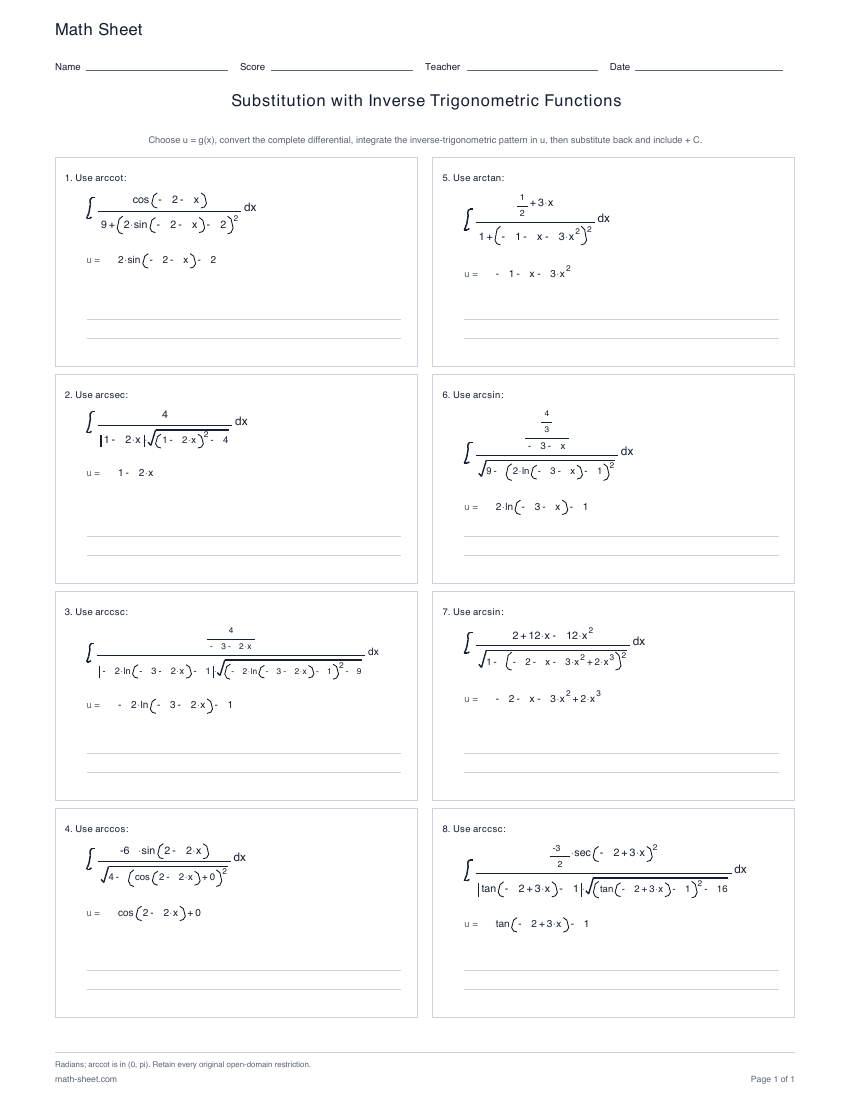
Substitution with inverse trigonometric functions worksheets
Practice indefinite u-substitution into all six inverse-trigonometric integration patterns with polynomial, logarithmic and trigonometric inner functions.
Preview and downloadCalculus practice
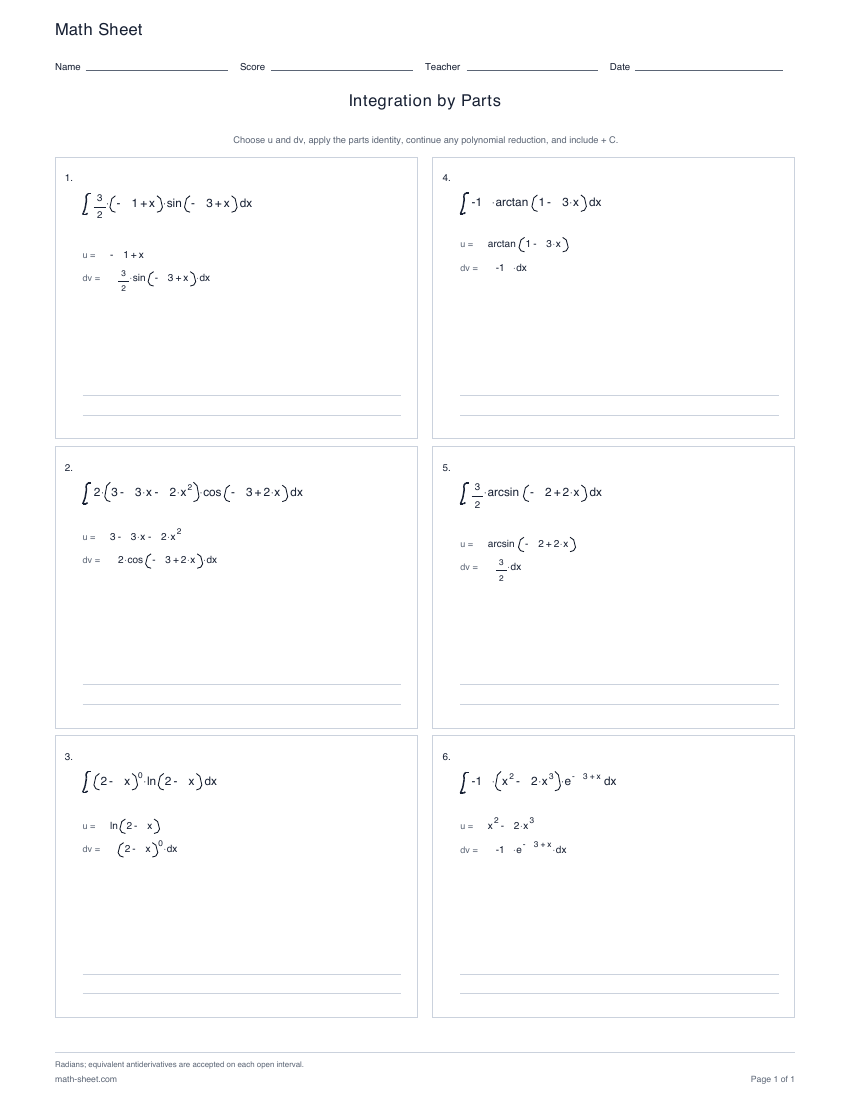
Practice exact integration by parts with polynomial-exponential, polynomial-trigonometric, logarithmic and inverse-trigonometric integrands.
Ready-made English PDF · fixed settings
Customization below makes a separate PDF.
Fixed English ready-made files. Custom settings below apply only to the configured PDF.
Ready to print
Choose u and dv, apply the parts identity, continue any polynomial reduction, and include + C.
Download the practice pages alone, or include a separate answer key or teacher model. Longer activities may use more than one page.
Customize this worksheetEach polynomial stage differentiates the polynomial and integrates the exponential or trigonometric factor. The worked key shows every complete differential and collects the final exact terms.
Learning objective
Choose u and dv, track complete differentials, repeat parts for polynomial products, and state the real domain of the original integrand.
Worked example
Choose u = x and dv = e^x dx. Then du = dx and v = e^x, so ∫ x e^x dx = x e^x − ∫ e^x dx = (x − 1)e^x + C.
Differentiating gives e^x + (x − 1)e^x = x e^x, the original integrand. Choosing the polynomial as u reduces its degree; this is why the remaining integral is easier.
Teaching notes
Integration by parts follows from the product rule: ∫ u dv = uv − ∫ v du. Before calculating, choose u so that differentiating it simplifies the product, and choose dv with an antiderivative you can find. In ∫ x e^x dx, differentiating x is useful; choosing u = e^x and dv = x dx makes the remaining polynomial degree larger instead.
These configurable worksheets cover bounded polynomial-exponential and polynomial-trigonometric products, logarithmic forms and inverse-trigonometric forms. Repeated parts reduces a polynomial one degree at a time. Keep the full differential, affine slope factors, original real domain and constant of integration visible. This resource does not replace a general integration-methods course.
For teaching, begin with one-step polynomial products and ask learners to explain why their choice simplifies the integral. Progress to repeated parts and domain-sensitive forms only after the first identity is secure. Print Letter or A4 practice with a separate worked answer section; use derivative checks to discuss an error before assigning a fresh set.
Look for a product in which differentiating one factor simplifies it and integrating the other is manageable. Substitution is often better when an inner function and its derivative appear together. Structure, rather than a product symbol alone, decides the method.
Differentiate the complete antiderivative. For (x − 1)e^x, the product rule returns e^x + (x − 1)e^x = x e^x. A plus sign in (x + 1)e^x would leave an unwanted 2e^x.
Make it yours
Choose your options, update the preview, then download the exact same pages.
Choose 6 or 8 problems, the integration families, and whether to supply u and dv.
A useful next step
Calculus
Practice indefinite u-substitution into all six inverse-trigonometric integration patterns with polynomial, logarithmic and trigonometric inner functions.
Preview and download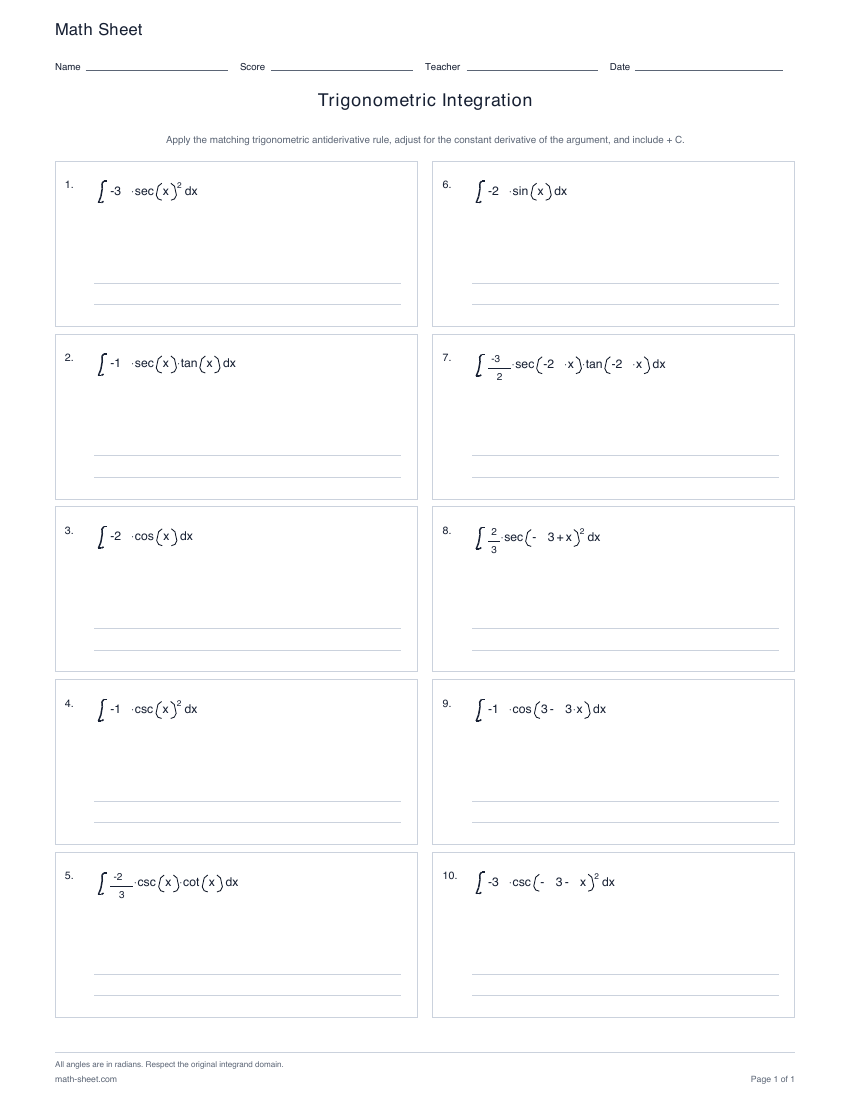
Calculus
Practice six direct trigonometric antiderivative patterns with exact constant coefficients and unit or affine arguments in radians.
Preview and download