
1 page · US Letter / A4
Grade 11 Math Cheat Sheet
A printable Grade 11 algebra reference for piecewise functions, polynomial and rational expressions, logs, sequences and complex numbers.
Customize in the Cheat Sheet Maker →
Read the reference on this page
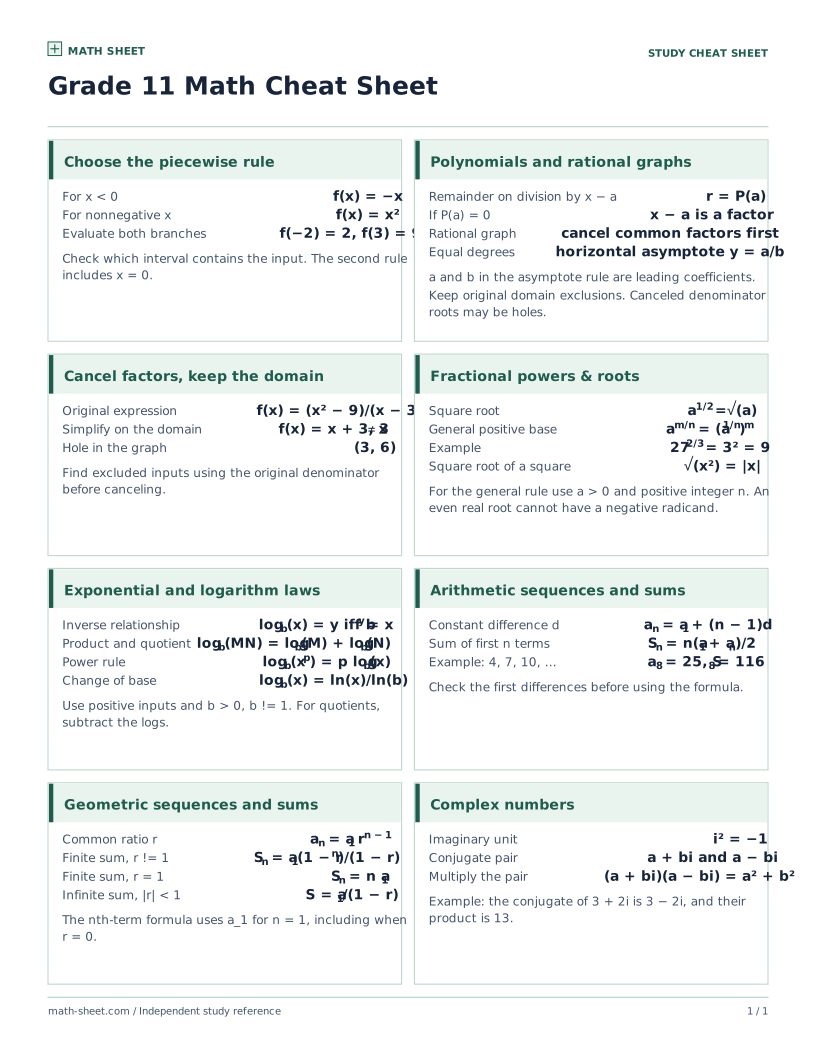
Choose the piecewise rule
- For x < 0
- f(x) = −x
- For nonnegative x
- f(x) = x²
- Evaluate both branches
- f(−2) = 2, f(3) = 9
Check which interval contains the input. The second rule includes x = 0.
Polynomials and rational graphs
- Remainder on division by x − a
- r = P(a)
- If P(a) = 0
- x − a is a factor
- Rational graph
- cancel common factors first
- Equal degrees
- horizontal asymptote y = a/b
a and b in the asymptote rule are leading coefficients.
Keep original domain exclusions. Canceled denominator roots may be holes.
Cancel factors, keep the domain
- Original expression
- f(x) = (x² − 9)/(x − 3)
- Simplify on the domain
- f(x) = x + 3, x ≠ 3
- Hole in the graph
- (3, 6)
Find excluded inputs using the original denominator before canceling.
Fractional powers & roots
- Square root
- a1/2 = √(a)
- General positive base
- am/n = (a1/n)m
- Example
- 272/3 = 3² = 9
- Square root of a square
- √(x²) = |x|
For the general rule use a > 0 and positive integer n. An even real root cannot have a negative radicand.
Exponential and logarithm laws
- Inverse relationship
- logb(x) = y iff by = x
- Product and quotient
- logb(MN) = logb(M) + logb(N)
- Power rule
- logb(xp) = p logb(x)
- Change of base
- logb(x) = ln(x)/ln(b)
Use positive inputs and b > 0, b != 1. For quotients, subtract the logs.
Arithmetic sequences and sums
- Constant difference d
- an = a1 + (n − 1)d
- Sum of first n terms
- Sn = n(a1 + an)/2
- Example: 4, 7, 10, ...
- a8 = 25, S8 = 116
Check the first differences before using the formula.
Geometric sequences and sums
- Common ratio r
- an = a1 rn − 1
- Finite sum, r != 1
- Sn = a1(1 − rn)/(1 − r)
- Finite sum, r = 1
- Sn = n a1
- Infinite sum, |r| < 1
- S = a1/(1 − r)
The nth-term formula uses a_1 for n = 1, including when r = 0.
Complex numbers
- Imaginary unit
- i² = −1
- Conjugate pair
- a + bi and a − bi
- Multiply the pair
- (a + bi)(a − bi) = a² + b²
Example: the conjugate of 3 + 2i is 3 − 2i, and their product is 13.