Statistics practice

Parameters, Statistics, and Inference worksheets

Classify study stages, identify observations and parameters, reject invalid statistics, and compute sample summaries.

Ready-made English PDF · fixed settings

Customization below makes a separate PDF.

Fixed English ready-made files. Custom settings below apply only to the configured PDF.

Ready to print

Start with a ready-made worksheet

Distinguish population parameters from sample observations and statistics. A statistic may depend only on observed sample values and known constants.

Download the practice pages alone, or include a separate answer key or teacher model. Longer activities may use more than one page.

Customize this worksheet

Paper sizes and printing help · More statistics activities

Make the mathematical structure visible

Each problem prints the support, table, model assumptions, or sample convention needed to solve it on paper. Student pages reserve workspace; teacher downloads append a separate worked key generated from the same validated document.

Learning objective

What this activity builds

Separate observed sample information from unknown population quantities throughout the inference workflow.

Worked example

Is x-bar minus unknown mu a statistic?

No. It contains the unknown population parameter mu.

A statistic must be computable from the sample alone.

Teaching notes

Make the practice count

  • Name the population before naming its parameter.
  • Point to one concrete observation.
  • State the n-1 sample variance convention.

Make it yours

Customize the practice

Choose your options, update the preview, then download the exact same pages.

Choose one or more bounded question types, problem count, paper size, and seed.

Worksheet settings

Question types
Page note and reproducible seed

The same settings and seed make the same questions. Shared links include your page note; leave personal information out.

Configured PDF · Parameters, Statistics, and Inference · US Letter

Preview ready. Download includes these exact pages.

4 student pages
Enlarged pages scroll. PDF size stays the same.
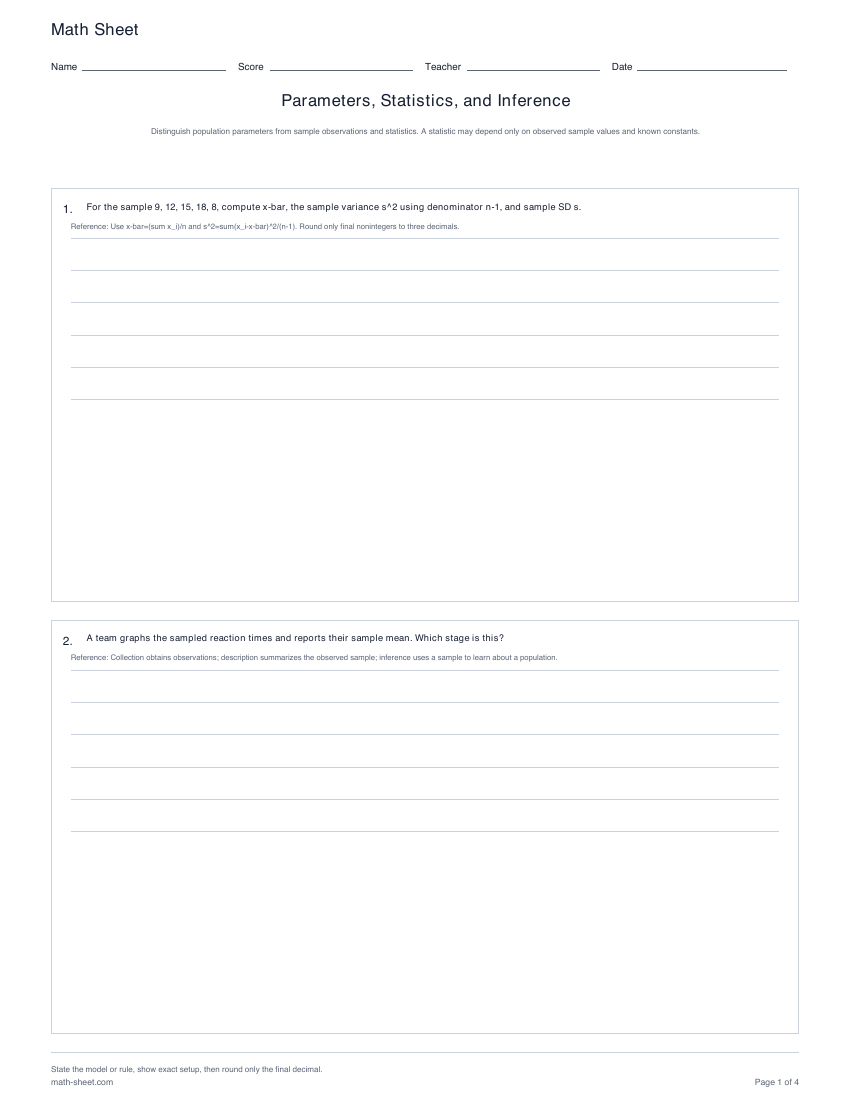
Math SheetNameScoreTeacherDateParameters, Statistics, and InferenceDistinguish population parameters from sample observations and statistics. A statistic may depend only on observed sample values and known constants.1.For the sample 9, 12, 15, 18, 8, compute x-bar, the sample variance s^2 using denominator n-1, and sample SD s.Reference: Use x-bar=(sum x_i)/n and s^2=sum(x_i-x-bar)^2/(n-1). Round only final nonintegers to three decimals.2.A team graphs the sampled reaction times and reports their sample mean. Which stage is this?Reference: Collection obtains observations; description summarizes the observed sample; inference uses a sample to learn about a population.State the model or rule, show exact setup, then round only the final decimal.math-sheet.comPage 1 of 4
Math SheetNameScoreTeacherDateParameters, Statistics, and InferenceDistinguish population parameters from sample observations and statistics. A statistic may depend only on observed sample values and known constants.3.For study 3 of sampled commute times, a student proposes sum(x_i-mu)^2/n as a statistic, where mu is the unknown population mean. Is it a statistic? Give avalid replacement.Reference: A statistic cannot contain an unknown population parameter; it must be computable from observed data and known constants.4.A population consists of all seedling heights. A random sample records 12, 15, 18, 8, 11. Identify one observation, the population mean parameter mu, and thesample-mean statistic.Reference: A parameter describes the population and is typically unknown. An observation is one recorded value. A statistic is computed only from sample observations and known constants.State the model or rule, show exact setup, then round only the final decimal.math-sheet.comPage 2 of 4
Math SheetNameScoreTeacherDateParameters, Statistics, and InferenceDistinguish population parameters from sample observations and statistics. A statistic may depend only on observed sample values and known constants.5.For study 5 of sampled battery lifetimes, a student proposes sum(x_i-mu)^2/n as a statistic, where mu is the unknown population mean. Is it a statistic? Give avalid replacement.Reference: A statistic cannot contain an unknown population parameter; it must be computable from observed data and known constants.6.A population consists of all weekly sales. A random sample records 14, 17, 20, 10, 13, 16, 19. Identify one observation, the population mean parameter mu,and the sample-mean statistic.Reference: A parameter describes the population and is typically unknown. An observation is one recorded value. A statistic is computed only from sample observations and known constants.State the model or rule, show exact setup, then round only the final decimal.math-sheet.comPage 3 of 4
Math SheetNameScoreTeacherDateParameters, Statistics, and InferenceDistinguish population parameters from sample observations and statistics. A statistic may depend only on observed sample values and known constants.7.A team randomly selects 40 records and measures reaction times. Which stage is this?Reference: Collection obtains observations; description summarizes the observed sample; inference uses a sample to learn about a population.8.For the sample 16, 19, 9, 12, 15, 18, compute x-bar, the sample variance s^2 using denominator n-1, and sample SD s.Reference: Use x-bar=(sum x_i)/n and s^2=sum(x_i-x-bar)^2/(n-1). Round only final nonintegers to three decimals.State the model or rule, show exact setup, then round only the final decimal.math-sheet.comPage 4 of 4

A useful next step

Related activities