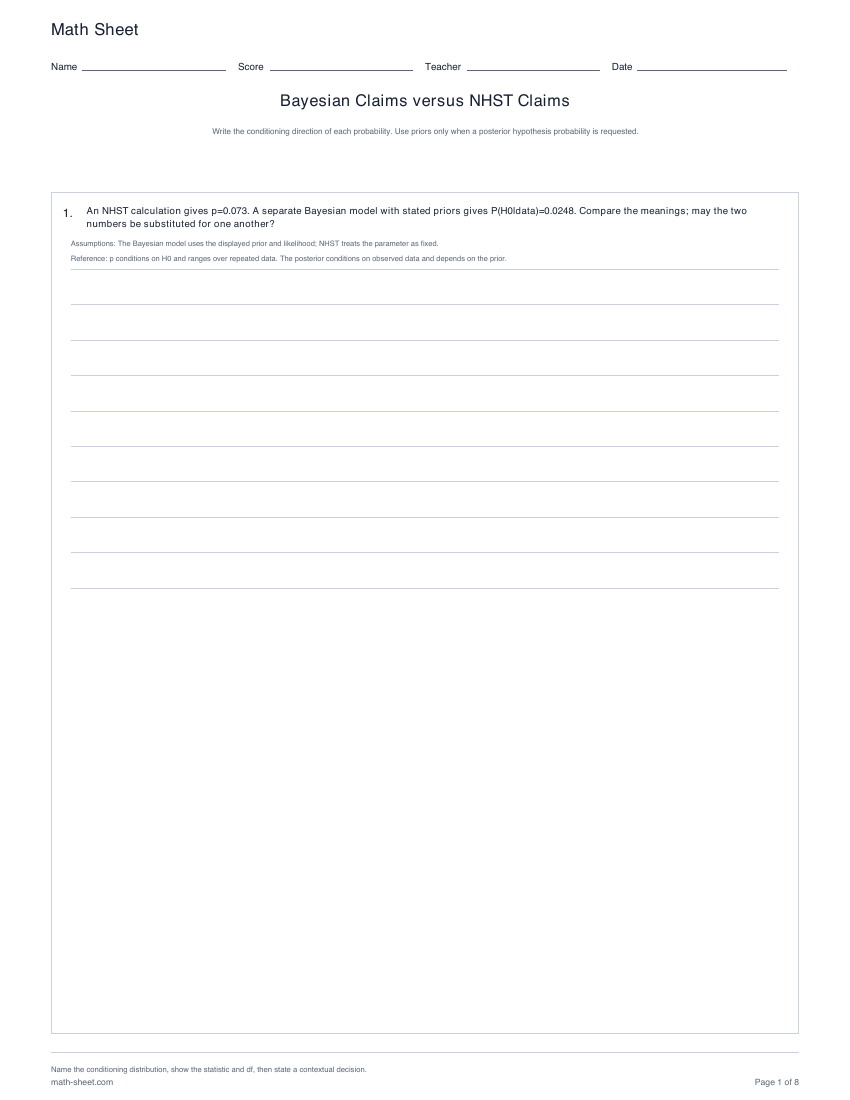
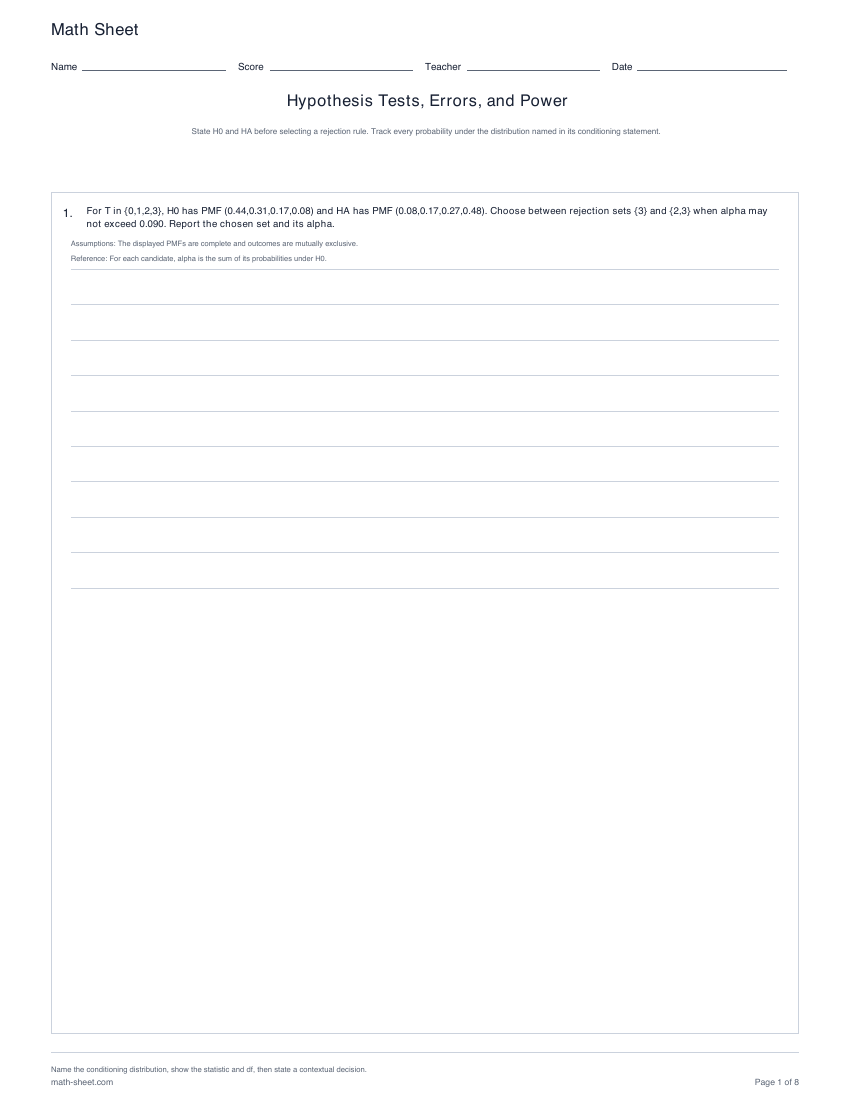
Math Sheet Name Score Teacher Date Bayesian Claims versus NHST Claims Write the conditioning direction of each probability. Use priors only when a posterior hypothesis probability is requested. 1. An NHST calculation gives p=0.073. A separate Bayesian model with stated priors gives P(H0|data)=0.0248. Compare the meanings; may the two numbers be substituted for one another? Assumptions: The Bayesian model uses the displayed prior and likelihood; NHST treats the parameter as fixed. Reference: p conditions on H0 and ranges over repeated data. The posterior conditions on observed data and depends on the prior. Name the conditioning distribution, show the statistic and df, then state a contextual decision. math-sheet.com Page 1 of 8
Math Sheet Name Score Teacher Date Bayesian Claims versus NHST Claims Write the conditioning direction of each probability. Use priors only when a posterior hypothesis probability is requested. 2. Before a test, P(H0)=0.68. The test has significance alpha=0.05 and power=0.8 for the stated alternative. Given that H0 was rejected, find P(H0 | reject). Assumptions: The prior places all probability on the stated null and alternative models; alpha and power apply to this test. Reference: Bayes: P(H0|R)=P(H0)P(R|H0)/[P(H0)P(R|H0)+P(HA)P(R|HA)]. Name the conditioning distribution, show the statistic and df, then state a contextual decision. math-sheet.com Page 2 of 8
Math Sheet Name Score Teacher Date Bayesian Claims versus NHST Claims Write the conditioning direction of each probability. Use priors only when a posterior hypothesis probability is requested. 3. Classify each statement: (A) "If the fixed null value were true, this rejection rule errs with probability 0.1." (B) "Given these data and a stated prior, the null model has probability 0.2222." Assumptions: The frequentist model treats the parameter as fixed across repetitions; the Bayesian model assigns probabilities to hypotheses through a prior. Reference: Frequentist error rates condition on a fixed hypothesis. Posterior beliefs condition on observed data and a prior. Name the conditioning distribution, show the statistic and df, then state a contextual decision. math-sheet.com Page 3 of 8
Math Sheet Name Score Teacher Date Bayesian Claims versus NHST Claims Write the conditioning direction of each probability. Use priors only when a posterior hypothesis probability is requested. 4. A report based on a sample-mean statistic gives p=0.106. Is this P(data as or more extreme | H0), P(H0 | data), or P(HA | data)? State the conditioning direction. Assumptions: The test statistic and null sampling model were fixed before observing the data. Reference: A p-value is a tail probability computed under H0; it is not a posterior hypothesis probability. Name the conditioning distribution, show the statistic and df, then state a contextual decision. math-sheet.com Page 4 of 8
Math Sheet Name Score Teacher Date Bayesian Claims versus NHST Claims Write the conditioning direction of each probability. Use priors only when a posterior hypothesis probability is requested. 5. Classify each statement: (A) "If the fixed null value were true, this rejection rule errs with probability 0.05." (B) "Given these data and a stated prior, the null model has probability 0.2." Assumptions: The frequentist model treats the parameter as fixed across repetitions; the Bayesian model assigns probabilities to hypotheses through a prior. Reference: Frequentist error rates condition on a fixed hypothesis. Posterior beliefs condition on observed data and a prior. Name the conditioning distribution, show the statistic and df, then state a contextual decision. math-sheet.com Page 5 of 8
Math Sheet Name Score Teacher Date Bayesian Claims versus NHST Claims Write the conditioning direction of each probability. Use priors only when a posterior hypothesis probability is requested. 6. An NHST calculation gives p=0.128. A separate Bayesian model with stated priors gives P(H0|data)=0.3684. Compare the meanings; may the two numbers be substituted for one another? Assumptions: The Bayesian model uses the displayed prior and likelihood; NHST treats the parameter as fixed. Reference: p conditions on H0 and ranges over repeated data. The posterior conditions on observed data and depends on the prior. Name the conditioning distribution, show the statistic and df, then state a contextual decision. math-sheet.com Page 6 of 8
Math Sheet Name Score Teacher Date Bayesian Claims versus NHST Claims Write the conditioning direction of each probability. Use priors only when a posterior hypothesis probability is requested. 7. Before a test, P(H0)=0.4. The test has significance alpha=0.01 and power=0.7 for the stated alternative. Given that H0 was rejected, find P(H0 | reject). Assumptions: The prior places all probability on the stated null and alternative models; alpha and power apply to this test. Reference: Bayes: P(H0|R)=P(H0)P(R|H0)/[P(H0)P(R|H0)+P(HA)P(R|HA)]. Name the conditioning distribution, show the statistic and df, then state a contextual decision. math-sheet.com Page 7 of 8
Math Sheet Name Score Teacher Date Bayesian Claims versus NHST Claims Write the conditioning direction of each probability. Use priors only when a posterior hypothesis probability is requested. 8. A report based on a sample-mean statistic gives p=0.018. Is this P(data as or more extreme | H0), P(H0 | data), or P(HA | data)? State the conditioning direction. Assumptions: The test statistic and null sampling model were fixed before observing the data. Reference: A p-value is a tail probability computed under H0; it is not a posterior hypothesis probability. Name the conditioning distribution, show the statistic and df, then state a contextual decision. math-sheet.com Page 8 of 8