Rational expressions practice

Graphing general rational functions worksheets

Analyze and graph rational functions whose numerator and denominator each have degree at most 2, including poles, removable holes and horizontal, slant or polynomial end behavior.

Ready-made English PDF · fixed settings

Customization below makes a separate PDF.

Fixed English ready-made files. Custom settings below apply only to the configured PDF.

Ready to print

Start with a ready-made worksheet

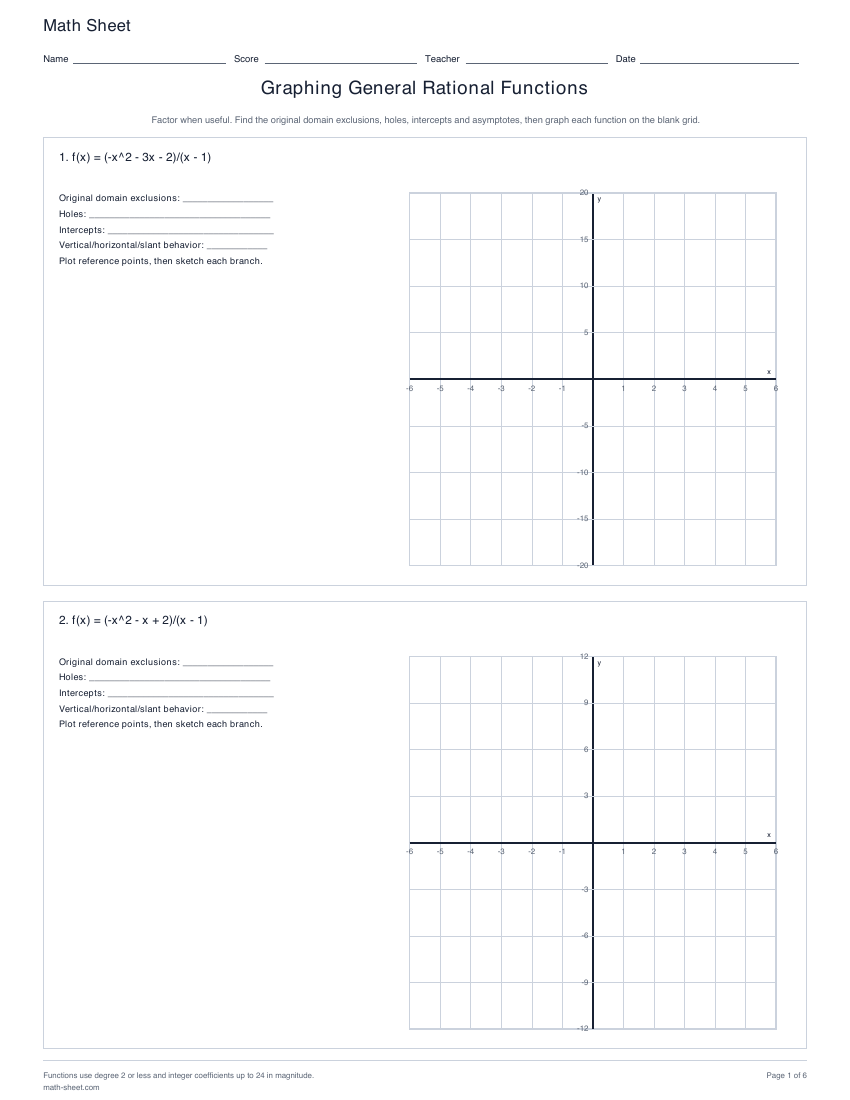
Factor when useful. Find the original domain exclusions, holes, intercepts and asymptotes, then graph each function on the blank grid.

Download the practice pages alone, or include a separate answer key or teacher model. Longer activities may use more than one page.

Customize this worksheet

Paper sizes and printing help · More rational expressions activities

Resolve the original domain before reducing

Each expression is resolved exactly before drawing. The key distinguishes remaining poles from fully canceled holes, excludes original denominator zeros from the intercepts and shows the correct horizontal, slant or polynomial end behavior.

The set uses useful classroom cases with nonzero numerators through degree 2 and nonconstant denominators through degree 2. It includes simple and repeated poles, two distinct poles, removable holes, no-real-pole cases and full cancellation to a polynomial.

Questions teachers ask

What the key records

The key lists original domain exclusions, the reduced expression, holes, intercepts and end behavior before showing the graph. Curves are split at poles, holes stay open and asymptotes are dashed.

Learning objective

What this activity builds

Use factoring, original domain exclusions, intercepts and end behavior to sketch a rational function accurately.

Worked example

What happens to f(x) = (x² - 1)/(x - 1) at x = 1?

The reduced rule is y = x + 1, with a hole at (1, 2).

The factor x - 1 cancels, but x = 1 was excluded by the original denominator. Plot the line and leave that point open.

Teaching notes

Make the practice count

  • List original denominator zeros before canceling factors.
  • Classify each excluded value as a hole or a pole after reduction.
  • Use polynomial division to identify horizontal, slant or polynomial end behavior.
  • Plot each interval between poles as its own branch.

Make it yours

Customize the practice

Choose your options, update the preview, then download the exact same pages.

Choose 4, 8 or 12 graphs. Student pages provide labeled blank grids; the separate key shows exact features and broken curve branches.

Worksheet settings

Native expressions have degree at most 2 and integer coefficients with absolute value at most 24.

Page note and reproducible seed

The same settings and seed make the same questions. Shared links include your page note; leave personal information out.

Configured PDF · Graphing General Rational Functions · US Letter

Preview ready. Download includes these exact pages.

6 student pages
Enlarged pages scroll. PDF size stays the same.
Math SheetNameScoreTeacherDateGraphing General Rational FunctionsFactor when useful. Find the original domain exclusions, holes, intercepts and asymptotes, then graph each function on the blank grid.1. f(x) = (-x^2 - 3x - 2)/(x - 1)-6-5-4-3-2-1123456-20-15-10-55101520xyOriginal domain exclusions: __________________Holes: ____________________________________Intercepts: _________________________________Vertical/horizontal/slant behavior: ____________Plot reference points, then sketch each branch.2. f(x) = (-x^2 - x + 2)/(x - 1)-6-5-4-3-2-1123456-12-9-6-336912xyOriginal domain exclusions: __________________Holes: ____________________________________Intercepts: _________________________________Vertical/horizontal/slant behavior: ____________Plot reference points, then sketch each branch.Functions use degree 2 or less and integer coefficients up to 24 in magnitude.Page 1 of 6math-sheet.com
Math SheetNameScoreTeacherDateGraphing General Rational FunctionsFactor when useful. Find the original domain exclusions, holes, intercepts and asymptotes, then graph each function on the blank grid.3. f(x) = (-x^2 + x - 3)/(x^2 - 3x + 2)-6-5-4-3-2-1123456-20-15-10-55101520xyOriginal domain exclusions: __________________Holes: ____________________________________Intercepts: _________________________________Vertical/horizontal/slant behavior: ____________Plot reference points, then sketch each branch.4. f(x) = (-1)/(x^2 - 3x + 2)-6-5-4-3-2-1123456-12-9-6-336912xyOriginal domain exclusions: __________________Holes: ____________________________________Intercepts: _________________________________Vertical/horizontal/slant behavior: ____________Plot reference points, then sketch each branch.Functions use degree 2 or less and integer coefficients up to 24 in magnitude.Page 2 of 6math-sheet.com
Math SheetNameScoreTeacherDateGraphing General Rational FunctionsFactor when useful. Find the original domain exclusions, holes, intercepts and asymptotes, then graph each function on the blank grid.5. f(x) = (-x - 2)/(x^2 - 2x + 1)-6-5-4-3-2-1123456-12-9-6-336912xyOriginal domain exclusions: __________________Holes: ____________________________________Intercepts: _________________________________Vertical/horizontal/slant behavior: ____________Plot reference points, then sketch each branch.6. f(x) = (-x + 1)/(x^2 - 2x + 1)-6-5-4-3-2-1123456-12-9-6-336912xyOriginal domain exclusions: __________________Holes: ____________________________________Intercepts: _________________________________Vertical/horizontal/slant behavior: ____________Plot reference points, then sketch each branch.Functions use degree 2 or less and integer coefficients up to 24 in magnitude.Page 3 of 6math-sheet.com
Math SheetNameScoreTeacherDateGraphing General Rational FunctionsFactor when useful. Find the original domain exclusions, holes, intercepts and asymptotes, then graph each function on the blank grid.7. f(x) = (-x + 1)/(x^2 - 3x + 2)-6-5-4-3-2-1123456-12-9-6-336912xyOriginal domain exclusions: __________________Holes: ____________________________________Intercepts: _________________________________Vertical/horizontal/slant behavior: ____________Plot reference points, then sketch each branch.8. f(x) = (-x^2 + x - 1)/(x^2 + 2x + 2)-6-5-4-3-2-1123456-12-9-6-336912xyOriginal domain exclusions: __________________Holes: ____________________________________Intercepts: _________________________________Vertical/horizontal/slant behavior: ____________Plot reference points, then sketch each branch.Functions use degree 2 or less and integer coefficients up to 24 in magnitude.Page 4 of 6math-sheet.com
Math SheetNameScoreTeacherDateGraphing General Rational FunctionsFactor when useful. Find the original domain exclusions, holes, intercepts and asymptotes, then graph each function on the blank grid.9. f(x) = (-x^2 - x - 1)/(x^2 - x)-6-5-4-3-2-1123456-12-9-6-336912xyOriginal domain exclusions: __________________Holes: ____________________________________Intercepts: _________________________________Vertical/horizontal/slant behavior: ____________Plot reference points, then sketch each branch.10. f(x) = (2x^2 + 6x + 4)/(x - 1)-6-5-4-3-2-1123456-30-20-10102030xyOriginal domain exclusions: __________________Holes: ____________________________________Intercepts: _________________________________Vertical/horizontal/slant behavior: ____________Plot reference points, then sketch each branch.Functions use degree 2 or less and integer coefficients up to 24 in magnitude.Page 5 of 6math-sheet.com
Math SheetNameScoreTeacherDateGraphing General Rational FunctionsFactor when useful. Find the original domain exclusions, holes, intercepts and asymptotes, then graph each function on the blank grid.11. f(x) = (2x^2 + 2x - 4)/(x - 1)-6-5-4-3-2-1123456-12-9-6-336912xyOriginal domain exclusions: __________________Holes: ____________________________________Intercepts: _________________________________Vertical/horizontal/slant behavior: ____________Plot reference points, then sketch each branch.12. f(x) = (2x^2 - 2x + 6)/(x^2 - 3x + 2)-6-5-4-3-2-1123456-40-30-20-1010203040xyOriginal domain exclusions: __________________Holes: ____________________________________Intercepts: _________________________________Vertical/horizontal/slant behavior: ____________Plot reference points, then sketch each branch.Functions use degree 2 or less and integer coefficients up to 24 in magnitude.Page 6 of 6math-sheet.com

A useful next step

Related activities

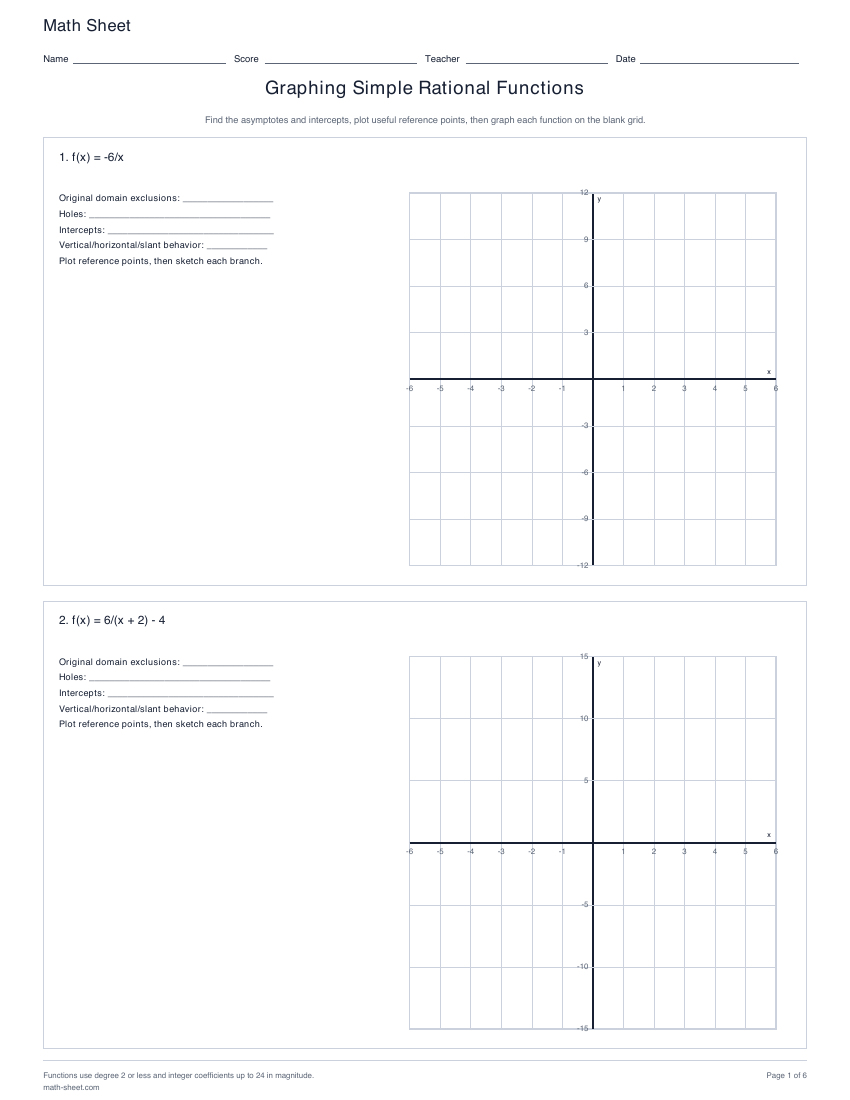
First page preview: Graphing simple rational functions worksheets

Rational expressions

Graphing simple rational functions worksheets

Graph reciprocal functions and their horizontal or vertical shifts on labeled grids, with exact asymptotes, intercepts and reference points in a separate answer key.

Preview and download
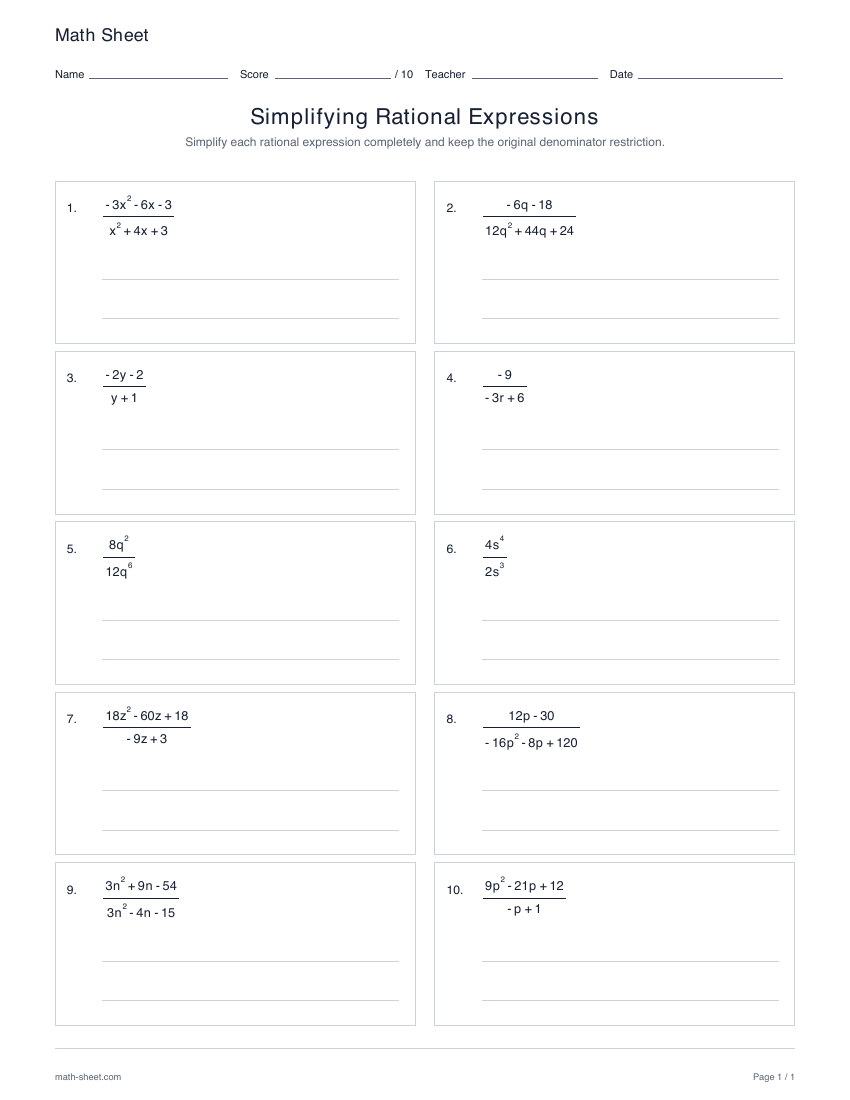
First page preview: Simplifying rational expressions worksheets

Rational expressions

Simplifying rational expressions worksheets

Practice ten exact single-quotient reductions with monomial, binomial or trinomial inputs, complete cancellation and retained original denominator restrictions.

Preview and download
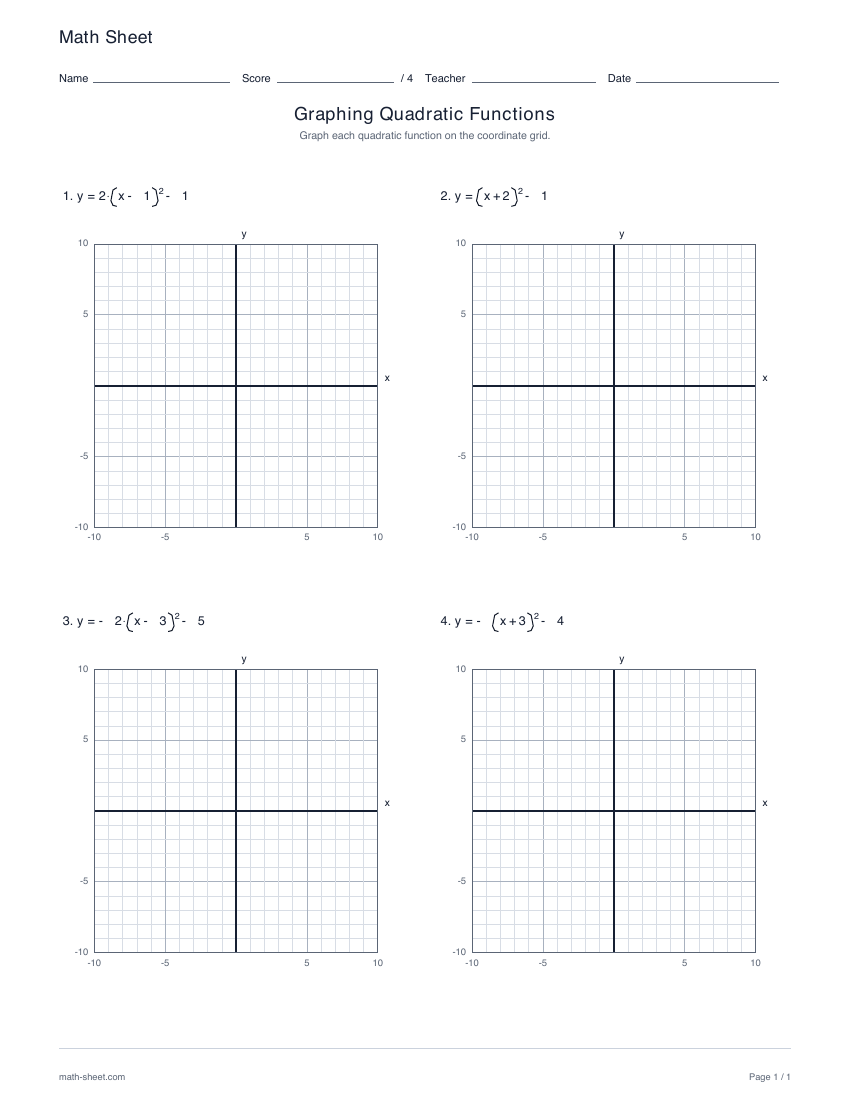
First page preview: Graphing quadratic functions worksheets

General functions

Graphing quadratic functions worksheets

Graph four quadratic functions in vertex form on blank coordinate grids. Each sheet includes every leading coefficient from −2, −1, 1 and 2, with a separate completed graph key.

Preview and download