Probability practice

Total Probability and Bayes' Theorem worksheets

Practice forward total probability and reverse conditional probability with explicit two- and three-source partitions.

Ready-made English PDF · fixed settings

Customization below makes a separate PDF.

Fixed English ready-made files. Custom settings below apply only to the configured PDF.

Ready to print

Start with a ready-made worksheet

Use the exhaustive, disjoint source branches. Show the total-event sum before any reverse conditional probability, then round only the final result.

Download the practice pages alone, or include a separate answer key or teacher model. Longer activities may use more than one page.

Customize this worksheet

Paper sizes and printing help · More probability activities

Keep the model visible

Each worksheet states the sample-space assumptions, distribution support, and counting convention needed for the selected model. Probability tables stay fully labeled, and Bayes questions identify the conditioning event before reversing it.

Learning objective

What this activity builds

Use exhaustive disjoint branches to find a total event probability, then reverse the conditioning correctly with Bayes' theorem.

Worked example

Sources A and B supply 40% and 60% of items; their pass rates are 80% and 90%. Find P(A | pass).

0.40(0.80) / [0.40(0.80)+0.60(0.90)] = 0.372.

The denominator is the total pass probability across both disjoint sources.

Teaching notes

Make the practice count

  • Label priors before conditional rates.
  • Compute the total conditioning-event probability before the Bayes numerator.
  • Check that posterior probabilities stay between 0 and 1.

Make it yours

Customize the practice

Choose your options, update the preview, then download the exact same pages.

Choose two- or three-source partitions, forward or reverse probability, final precision, and question count.

Worksheet settings

Source branches
Question types
Page note and reproducible seed

The same settings and seed make the same questions. Shared links include your page note; leave personal information out.

Configured PDF · Total Probability and Bayes' Theorem · US Letter

Preview ready. Download includes these exact pages.

4 student pages
Enlarged pages scroll. PDF size stays the same.
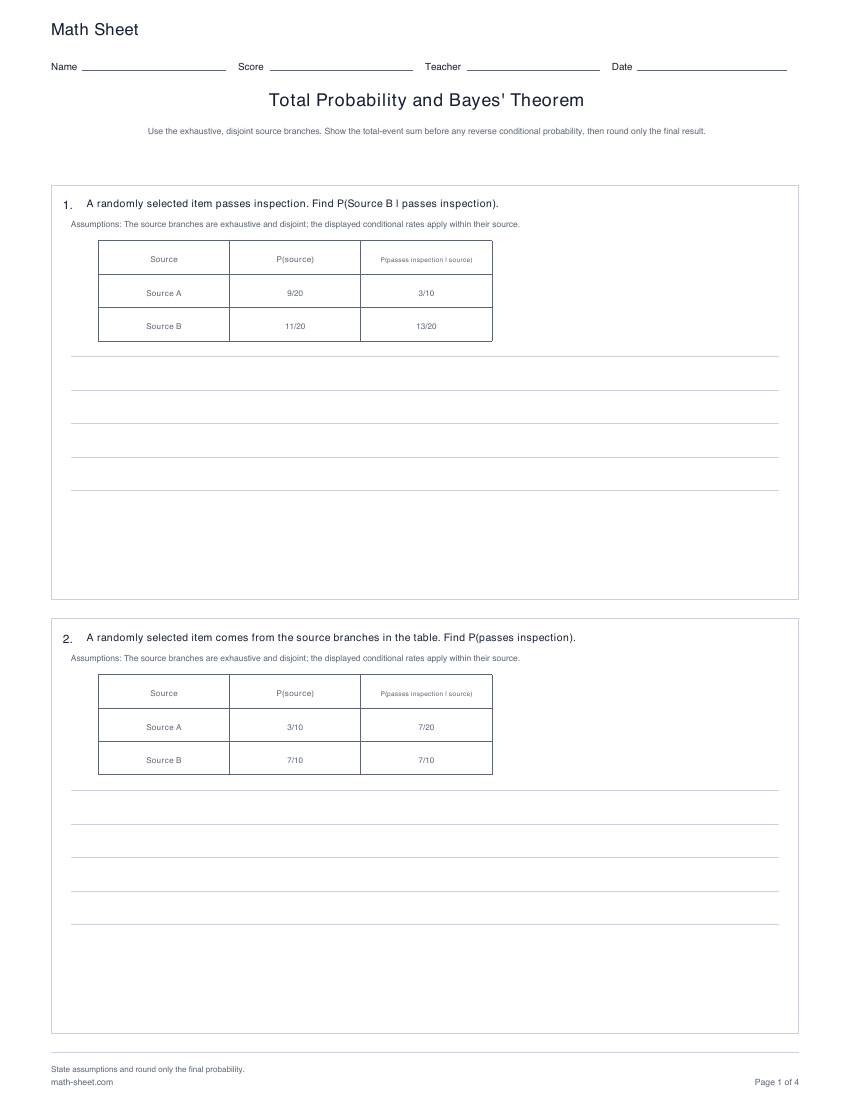
Math SheetNameScoreTeacherDateTotal Probability and Bayes' TheoremUse the exhaustive, disjoint source branches. Show the total-event sum before any reverse conditional probability, then round only the final result.1.A randomly selected item passes inspection. Find P(Source B | passes inspection).Assumptions: The source branches are exhaustive and disjoint; the displayed conditional rates apply within their source.SourceP(source)P(passes inspection | source)Source A9/203/10Source B11/2013/202.A randomly selected item comes from the source branches in the table. Find P(passes inspection).Assumptions: The source branches are exhaustive and disjoint; the displayed conditional rates apply within their source.SourceP(source)P(passes inspection | source)Source A3/107/20Source B7/107/10State assumptions and round only the final probability.math-sheet.comPage 1 of 4
Math SheetNameScoreTeacherDateTotal Probability and Bayes' TheoremUse the exhaustive, disjoint source branches. Show the total-event sum before any reverse conditional probability, then round only the final result.3.A randomly selected item comes from the source branches in the table. Find P(passes inspection).Assumptions: The source branches are exhaustive and disjoint; the displayed conditional rates apply within their source.SourceP(source)P(passes inspection | source)Source A1/511/20Source B7/209/10Source C9/202/54.A randomly selected item passes inspection. Find P(Source B | passes inspection).Assumptions: The source branches are exhaustive and disjoint; the displayed conditional rates apply within their source.SourceP(source)P(passes inspection | source)Source A1/101/4Source B7/203/5Source C11/201/10State assumptions and round only the final probability.math-sheet.comPage 2 of 4
Math SheetNameScoreTeacherDateTotal Probability and Bayes' TheoremUse the exhaustive, disjoint source branches. Show the total-event sum before any reverse conditional probability, then round only the final result.5.A randomly selected item passes inspection. Find P(Source B | passes inspection).Assumptions: The source branches are exhaustive and disjoint; the displayed conditional rates apply within their source.SourceP(source)P(passes inspection | source)Source A1/109/10Source B7/202/5Source C11/203/46.A randomly selected item comes from the source branches in the table. Find P(passes inspection).Assumptions: The source branches are exhaustive and disjoint; the displayed conditional rates apply within their source.SourceP(source)P(passes inspection | source)Source A3/1011/20Source B7/109/10State assumptions and round only the final probability.math-sheet.comPage 3 of 4
Math SheetNameScoreTeacherDateTotal Probability and Bayes' TheoremUse the exhaustive, disjoint source branches. Show the total-event sum before any reverse conditional probability, then round only the final result.7.A randomly selected item passes inspection. Find P(Source B | passes inspection).Assumptions: The source branches are exhaustive and disjoint; the displayed conditional rates apply within their source.SourceP(source)P(passes inspection | source)Source A9/203/4Source B11/201/48.A randomly selected item comes from the source branches in the table. Find P(passes inspection).Assumptions: The source branches are exhaustive and disjoint; the displayed conditional rates apply within their source.SourceP(source)P(passes inspection | source)Source A3/1013/20Source B1/43/20Source C9/201/2State assumptions and round only the final probability.math-sheet.comPage 4 of 4

A useful next step

Related activities