Probability practice

Exponential Distribution worksheets

Work with exponential waiting-time CDFs, survival probabilities, intervals, quantiles, moments, rate-mean conversion, and memorylessness.

Ready-made English PDF · fixed settings

Customization below makes a separate PDF.

Fixed English ready-made files. Custom settings below apply only to the configured PDF.

Ready to print

Start with a ready-made worksheet

Let T be a nonnegative waiting time with positive rate lambda. Convert rate and mean in matching units. Use a calculator for exponential and logarithm values. Round final probabilities to the configured 3 or 4 decimal places; use scientific notation when a rounded display would be 0. Round requested quantiles as stated.

Download the practice pages alone, or include a separate answer key or teacher model. Longer activities may use more than one page.

Customize this worksheet

Paper sizes and printing help · More probability activities

Keep the rate and units visible

Poisson sheets distinguish a rate per unit from lambda for the full exposure. Exponential sheets label lambda as a positive rate and connect it to the reciprocal mean waiting time.

Learning objective

What this activity builds

Interpret a positive exponential rate, convert between rate and mean, and choose the correct waiting-time probability, quantile, or memoryless relation.

Worked example

If lambda=1/2 per minute, find P(T>4).

P(T>4)=exp[-(1/2)(4)]=exp(-2), approximately 0.135.

The survival function gives the probability that the wait exceeds the stated time.

Teaching notes

Make the practice count

  • Check that rate and time use reciprocal units.
  • Use survival values directly for upper tails and interval differences.
  • For memorylessness, separate elapsed time s from additional time t.

Make it yours

Customize the practice

Choose your options, update the preview, then download the exact same pages.

Choose waiting-time, quantile, moment, or memoryless tasks; select rate or mean givens, precision, count, and seed.

Worksheet settings

Question types
Given parameter
Page note and reproducible seed

The same settings and seed make the same questions. Shared links include your page note; leave personal information out.

Configured PDF · Exponential Distribution · US Letter

Preview ready. Download includes these exact pages.

4 student pages
Enlarged pages scroll. PDF size stays the same.
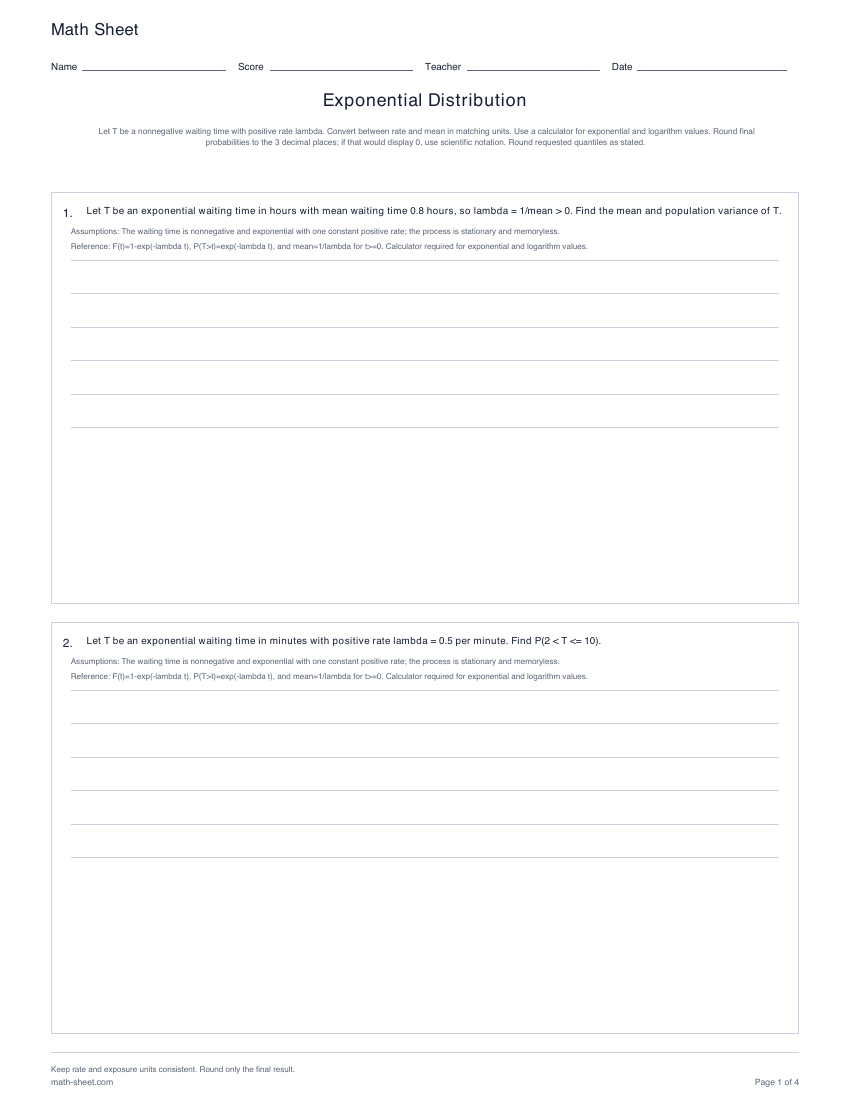
Math SheetNameScoreTeacherDateExponential DistributionLet T be a nonnegative waiting time with positive rate lambda. Convert between rate and mean in matching units. Use a calculator for exponential and logarithm values. Round finalprobabilities to the 3 decimal places; if that would display 0, use scientific notation. Round requested quantiles as stated.1.Let T be an exponential waiting time in hours with mean waiting time 0.8 hours, so lambda = 1/mean > 0. Find the mean and population variance of T.Assumptions: The waiting time is nonnegative and exponential with one constant positive rate; the process is stationary and memoryless.Reference: F(t)=1-exp(-lambda t), P(T>t)=exp(-lambda t), and mean=1/lambda for t>=0. Calculator required for exponential and logarithm values.2.Let T be an exponential waiting time in minutes with positive rate lambda = 0.5 per minute. Find P(2 < T <= 10).Assumptions: The waiting time is nonnegative and exponential with one constant positive rate; the process is stationary and memoryless.Reference: F(t)=1-exp(-lambda t), P(T>t)=exp(-lambda t), and mean=1/lambda for t>=0. Calculator required for exponential and logarithm values.Keep rate and exposure units consistent. Round only the final result.math-sheet.comPage 1 of 4
Math SheetNameScoreTeacherDateExponential DistributionLet T be a nonnegative waiting time with positive rate lambda. Convert between rate and mean in matching units. Use a calculator for exponential and logarithm values. Round finalprobabilities to the 3 decimal places; if that would display 0, use scientific notation. Round requested quantiles as stated.3.Let T be an exponential waiting time in hours with mean waiting time 5 hours, so lambda = 1/mean > 0. Find P(T > 8).Assumptions: The waiting time is nonnegative and exponential with one constant positive rate; the process is stationary and memoryless.Reference: F(t)=1-exp(-lambda t), P(T>t)=exp(-lambda t), and mean=1/lambda for t>=0. Calculator required for exponential and logarithm values.4.Let T be an exponential waiting time in hours with positive rate lambda = 0.125 per hour. Find q such that P(T <= q) = 0.2. Round q to the nearestthousandth.Assumptions: The waiting time is nonnegative and exponential with one constant positive rate; the process is stationary and memoryless.Reference: F(t)=1-exp(-lambda t), P(T>t)=exp(-lambda t), and mean=1/lambda for t>=0. Calculator required for exponential and logarithm values.Keep rate and exposure units consistent. Round only the final result.math-sheet.comPage 2 of 4
Math SheetNameScoreTeacherDateExponential DistributionLet T be a nonnegative waiting time with positive rate lambda. Convert between rate and mean in matching units. Use a calculator for exponential and logarithm values. Round finalprobabilities to the 3 decimal places; if that would display 0, use scientific notation. Round requested quantiles as stated.5.Let T be an exponential waiting time in minutes with positive rate lambda = 0.25 per minute. Given that T > 0.5, find P(T > 6.5 | T > 0.5).Assumptions: The waiting time is nonnegative and exponential with one constant positive rate; the process is stationary and memoryless.Reference: F(t)=1-exp(-lambda t), P(T>t)=exp(-lambda t), and mean=1/lambda for t>=0. Calculator required for exponential and logarithm values.6.Let T be an exponential waiting time in minutes with mean waiting time 0.5 minutes, so lambda = 1/mean > 0. Find P(T <= 4).Assumptions: The waiting time is nonnegative and exponential with one constant positive rate; the process is stationary and memoryless.Reference: F(t)=1-exp(-lambda t), P(T>t)=exp(-lambda t), and mean=1/lambda for t>=0. Calculator required for exponential and logarithm values.Keep rate and exposure units consistent. Round only the final result.math-sheet.comPage 3 of 4
Math SheetNameScoreTeacherDateExponential DistributionLet T be a nonnegative waiting time with positive rate lambda. Convert between rate and mean in matching units. Use a calculator for exponential and logarithm values. Round finalprobabilities to the 3 decimal places; if that would display 0, use scientific notation. Round requested quantiles as stated.7.Let T be an exponential waiting time in hours with mean waiting time 2 hours, so lambda = 1/mean > 0. Find P(T > 4).Assumptions: The waiting time is nonnegative and exponential with one constant positive rate; the process is stationary and memoryless.Reference: F(t)=1-exp(-lambda t), P(T>t)=exp(-lambda t), and mean=1/lambda for t>=0. Calculator required for exponential and logarithm values.8.Let T be an exponential waiting time in hours with positive rate lambda = 0.2 per hour. Given that T > 2, find P(T > 7 | T > 2).Assumptions: The waiting time is nonnegative and exponential with one constant positive rate; the process is stationary and memoryless.Reference: F(t)=1-exp(-lambda t), P(T>t)=exp(-lambda t), and mean=1/lambda for t>=0. Calculator required for exponential and logarithm values.Keep rate and exposure units consistent. Round only the final result.math-sheet.comPage 4 of 4

A useful next step

Related activities

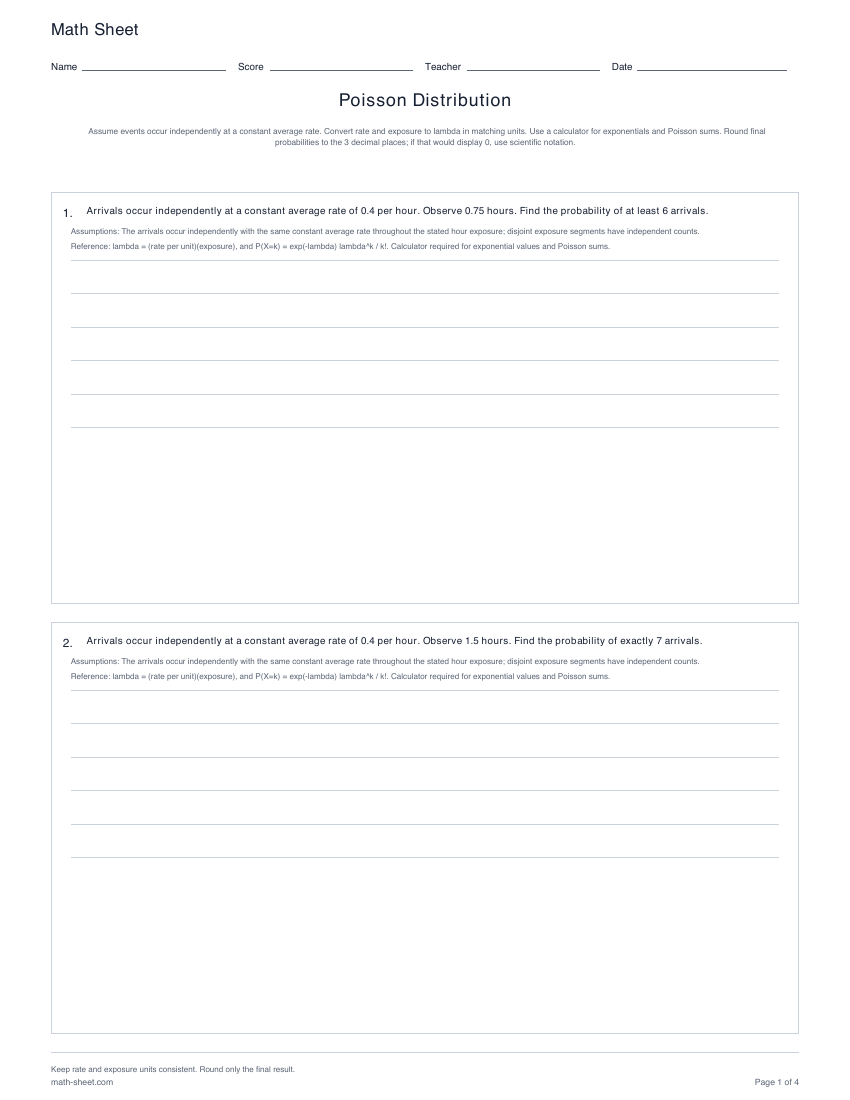
Printable poisson distribution worksheets preview

Probability

Poisson Distribution worksheets

Scale a constant event rate to an exposure, then calculate exact, cumulative, tail, mean, and variance results for Poisson counts.

Preview and download