
Probability
Geometric Distribution worksheets
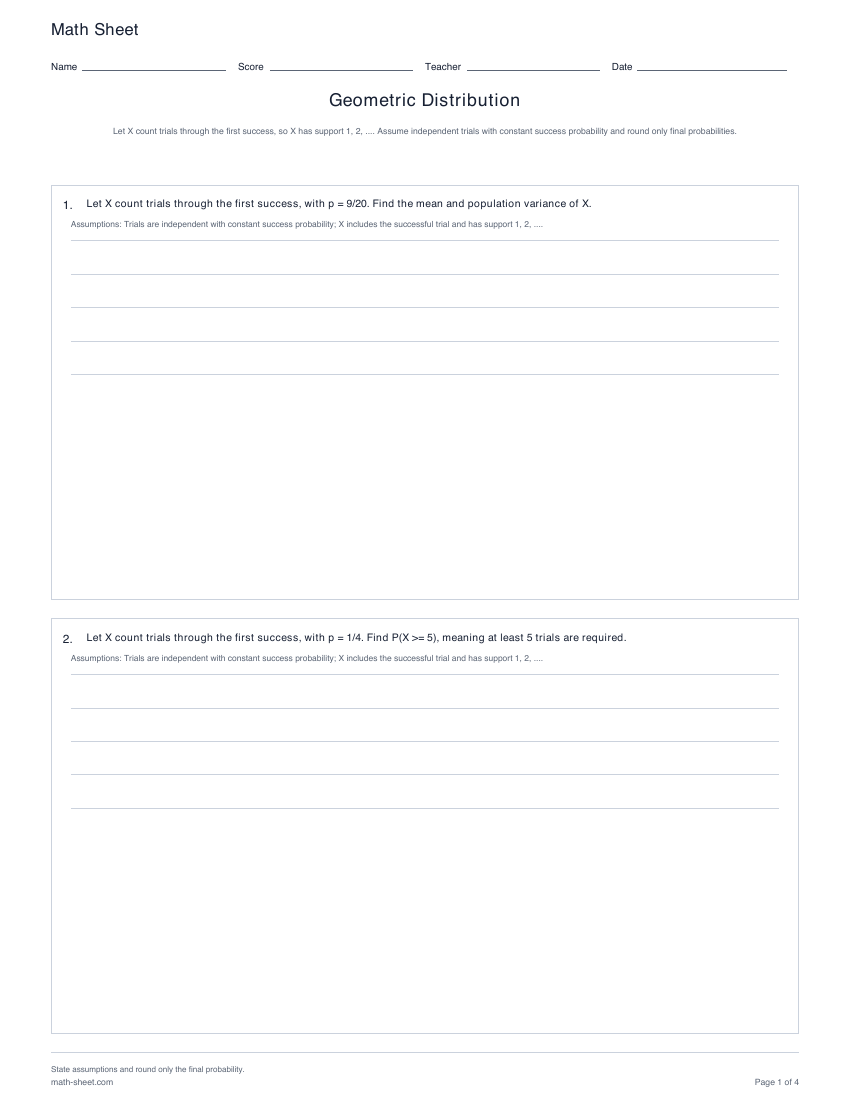
Model the number of trials through the first success using exact, cumulative, tail, mean, and variance questions.
Preview and downloadProbability practice
Calculate exact, at-most, and at-least binomial probabilities plus mean and variance for bounded trial counts.
Ready-made English PDF · fixed settings
Customization below makes a separate PDF.
Fixed English ready-made files. Custom settings below apply only to the configured PDF.
Ready to print
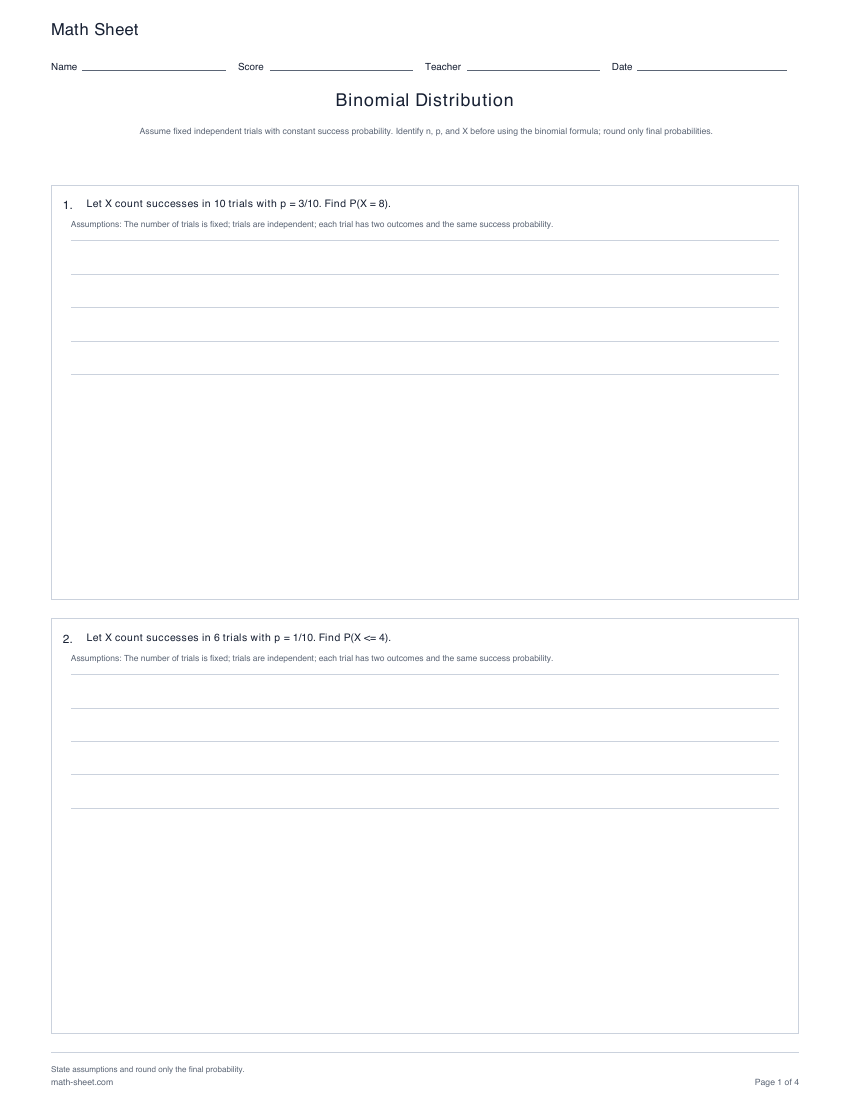
Assume fixed independent trials with constant success probability. Identify n, p, and X before using the binomial formula; round only final probabilities.
Download the practice pages alone, or include a separate answer key or teacher model. Longer activities may use more than one page.
Customize this worksheetEach worksheet states the sample-space assumptions, distribution support, and counting convention needed for the selected model. Probability tables stay fully labeled, and Bayes questions identify the conditioning event before reversing it.
Learning objective
Recognize a binomial setting and use its probability formula, complements, mean, and population variance.
Worked example
C(5,2)(1/2)^2(1/2)^3 = 10/32 = 0.3125.
The combination counts placements of two successes among five independent trials.
Teaching notes
Make it yours
Choose your options, update the preview, then download the exact same pages.
Choose exact, cumulative, tail, or moment tasks, bounded difficulty, precision, and question count. Keep the seed to reproduce the same worksheet.
A useful next step
Probability
Model the number of trials through the first success using exact, cumulative, tail, mean, and variance questions.
Preview and download