Calculus practice

Parametric Calculus worksheets

Differentiate bounded polynomial and trigonometric parametric curves, classify tangents, and calculate speed, arc length, and enclosed area.

Ready-made English PDF · fixed settings

Customization below makes a separate PDF.

Fixed English ready-made files. Custom settings below apply only to the configured PDF.

Ready to print

Start with a ready-made worksheet

Show derivatives with respect to t, verify tangent conditions, and keep the stated traversal bounds.

Download the practice pages alone, or include a separate answer key or teacher model. Longer activities may use more than one page.

Customize this worksheet

Paper sizes and printing help · More calculus activities

Bounds and derivative conditions carry the mathematics

These worksheets keep each curve on a bounded two-dimensional trace. Tangent classifications verify the companion derivative, and integral applications distinguish geometric quantities from signed orientation.

Learning objective

What this activity builds

Use dx/dt and dy/dt to reason about slope and curvature while preserving parameter bounds and traversal orientation in applications.

Worked example

When is a parametric tangent horizontal?

When dy/dt=0 and dx/dt is nonzero.

The companion nonzero condition is essential; if both derivatives vanish, the quotient does not classify the tangent.

Teaching notes

Make the practice count

  • Compute dx/dt and dy/dt before forming dy/dx.
  • For d²y/dx², differentiate dy/dx with respect to t and divide by dx/dt again.
  • Use absolute value when orientation reverses a signed area integral.

Make it yours

Customize the practice

Choose your options, update the preview, then download the exact same pages.

Choose bounded polynomial or trigonometric curves. Calculus level must match the selected derivative or application task modes; mixed accepts both. Omitting orientation removes optional sketch prompts, while area tasks retain the traversal direction needed for signed integrals.

Worksheet settings

Task modes
Curve families

Omit removes optional direction questions and sketch arrows. Area tasks still state traversal direction because it is required to interpret the signed integral.

Derivative level uses interpretation, slope, second derivative, and tangent classification. Applications uses speed, arc length, and area. Mixed uses selected modes from both groups.

Page note and reproducible seed

The same settings and seed make the same questions. Shared links include your page note; leave personal information out.

Configured PDF · Parametric Calculus · US Letter

Preview ready. Download includes these exact pages.

3 student pages
Enlarged pages scroll. PDF size stays the same.
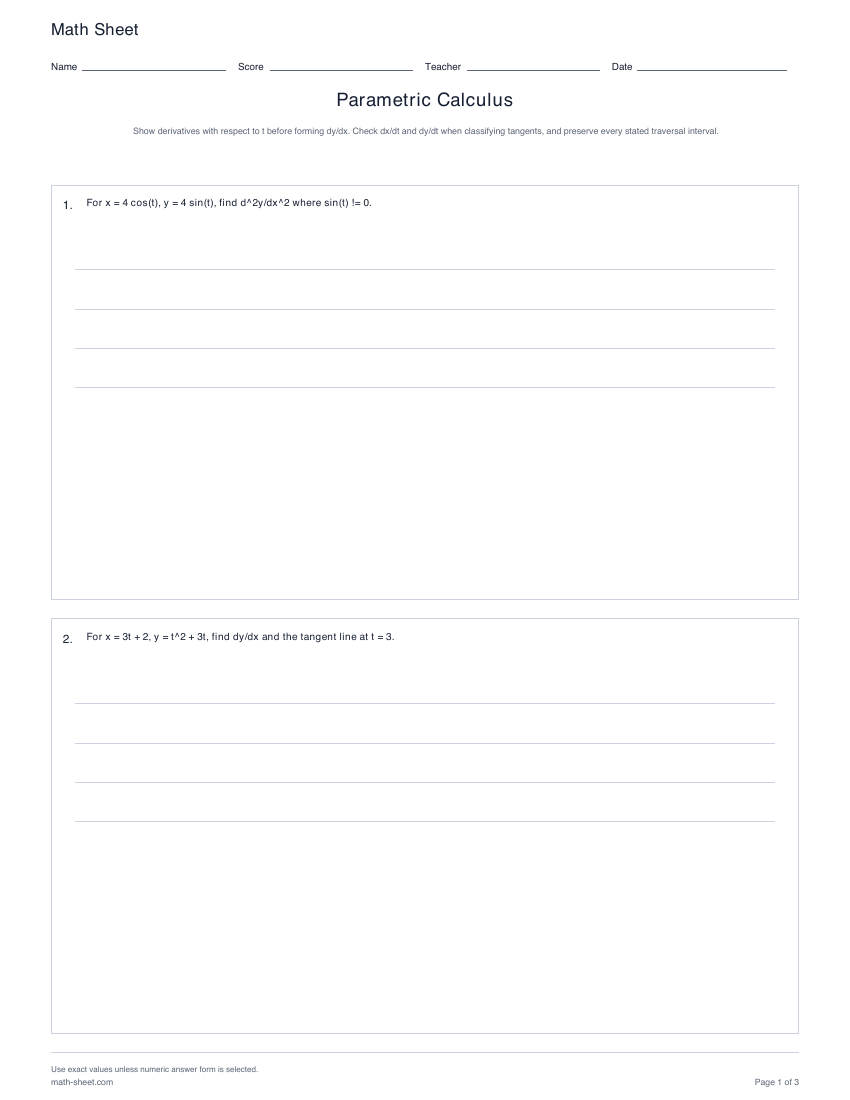
Math SheetNameScoreTeacherDateParametric CalculusShow derivatives with respect to t before forming dy/dx. Check dx/dt and dy/dt when classifying tangents, and preserve every stated traversal interval.1.For x = 4 cos(t), y = 4 sin(t), find d^2y/dx^2 where sin(t) != 0.2.For x = 3t + 2, y = t^2 + 3t, find dy/dx and the tangent line at t = 3.Use exact values unless numeric answer form is selected.math-sheet.comPage 1 of 3
Math SheetNameScoreTeacherDateParametric CalculusShow derivatives with respect to t before forming dy/dx. Check dx/dt and dy/dt when classifying tangents, and preserve every stated traversal interval.3.For the parametric curve shown by x = 6 cos(t), y = 6 sin(t), 0 <= t <= 2pi, make a value table and sketch the traced curve with arrows forincreasing t.t0pi2pi(x,y)-7-3.53.574.Find horizontal and vertical tangents for x = t^2 + 0, y = t^3 - 108t. Verify the companion derivative is nonzero.Use exact values unless numeric answer form is selected.math-sheet.comPage 2 of 3
Math SheetNameScoreTeacherDateParametric CalculusShow derivatives with respect to t before forming dy/dx. Check dx/dt and dy/dt when classifying tangents, and preserve every stated traversal interval.5.The arc x = t, y = 21(1 - t^2), -1 <= t <= 1, is traversed left to right and closed by the x-axis. Find the enclosed area with correct bounds andorientation.6.For x = 9 cos(t), y = -9 sin(t), find speed and arc length on 0 <= t <= 4pi/2.Use exact values unless numeric answer form is selected.math-sheet.comPage 3 of 3

A useful next step

Related activities

Printable polar calculus worksheets preview

Calculus

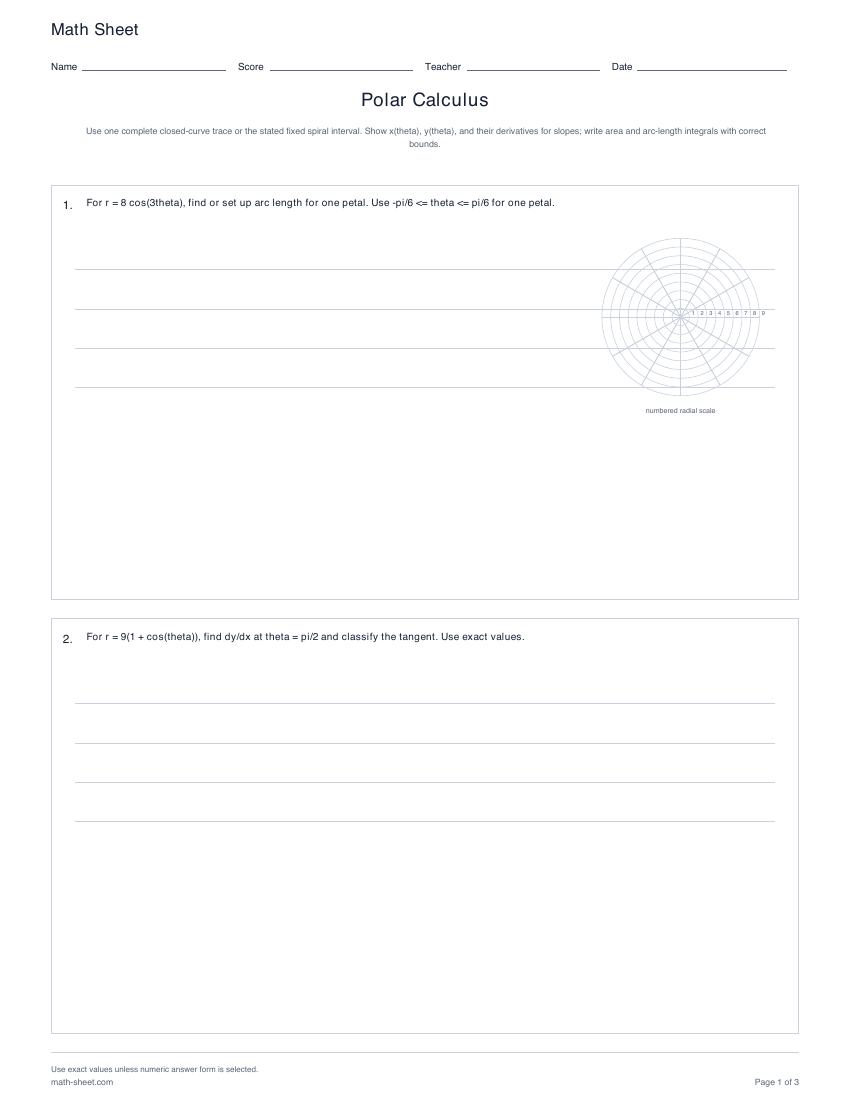
Polar Calculus worksheets

Find polar slopes and tangents, area over one trace, and bounded arc length for familiar circle, cardioid, rose, limacon, and spiral curves.

Preview and download