Calculus practice

Exponential Growth and Decay worksheets

Build and solve contextual continuous, periodic, doubling, half-life, and observation-based exponential models.

Ready-made English PDF · fixed settings

Customization below makes a separate PDF.

Fixed English ready-made files. Custom settings below apply only to the configured PDF.

Ready to print

Start with a ready-made worksheet

Write an exact exponential model, solve the stated question, and round only the final contextual answer.

Download the practice pages alone, or include a separate answer key or teacher model. Longer activities may use more than one page.

Customize this worksheet

Paper sizes and printing help · More calculus activities

Calibrate before solving

Each task turns contextual data into an exact rate constant and model before asking for an amount or time.

Learning objective

What this activity builds

Translate contextual growth and decay information into Q(t)=Ae^(k(t-t0)) and answer amount or target-time questions.

Worked example

A culture doubles every 4 hours. How is k found?

k=ln(2)/4.

The relation e^(4k)=2 gives the continuous rate constant without rounding.

Teaching notes

Make the practice count

  • Distinguish a continuous rate k from a periodic multiplier.
  • Keep logarithms exact until the final approximation.
  • For observations, preserve the stated nonzero time origin.

Make it yours

Customize the practice

Choose your options, update the preview, then download the exact same pages.

Choose 6 or 8 contextual modeling tasks covering continuous and periodic rates, doubling and half-life, and two-observation calibration.

Worksheet settings

Page note and reproducible seed

The same settings and seed make the same questions. Shared links include your page note; leave personal information out.

Configured PDF · Exponential Growth and Decay · US Letter

Preview ready. Download includes these exact pages.

2 student pages
Enlarged pages scroll. PDF size stays the same.
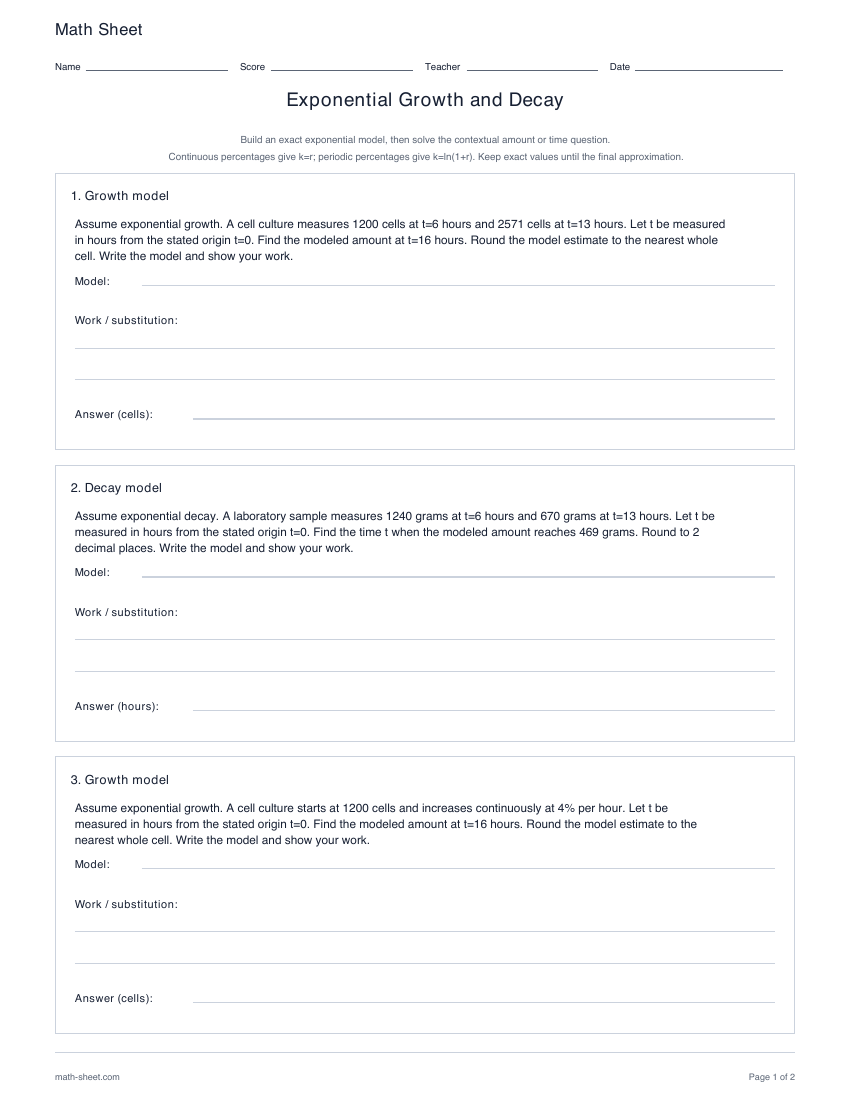
Math SheetNameScoreTeacherDateExponential Growth and DecayBuild an exact exponential model, then solve the contextual amount or time question.Continuous percentages give k=r; periodic percentages give k=ln(1+r). Keep exact values until the final approximation.1. Growth modelAssume exponential growth. A cell culture measures 1200 cells at t=6 hours and 2571 cells at t=13 hours. Let t be measuredin hours from the stated origin t=0. Find the modeled amount at t=16 hours. Round the model estimate to the nearest wholecell. Write the model and show your work.Model:Work / substitution:Answer (cells):2. Decay modelAssume exponential decay. A laboratory sample measures 1240 grams at t=6 hours and 670 grams at t=13 hours. Let t bemeasured in hours from the stated origin t=0. Find the time t when the modeled amount reaches 469 grams. Round to 2decimal places. Write the model and show your work.Model:Work / substitution:Answer (hours):3. Growth modelAssume exponential growth. A cell culture starts at 1200 cells and increases continuously at 4% per hour. Let t bemeasured in hours from the stated origin t=0. Find the modeled amount at t=16 hours. Round the model estimate to thenearest whole cell. Write the model and show your work.Model:Work / substitution:Answer (cells):math-sheet.comPage 1 of 2
Math SheetNameScoreTeacherDateExponential Growth and DecayBuild an exact exponential model, then solve the contextual amount or time question.Continuous percentages give k=r; periodic percentages give k=ln(1+r). Keep exact values until the final approximation.4. Decay modelAssume exponential decay. A laboratory sample starts at 1240 grams and decreases continuously at 4% per hour. Let t bemeasured in hours from the stated origin t=0. Find the time t when the modeled amount reaches 620 grams. Round to 2decimal places. Write the model and show your work.Model:Work / substitution:Answer (hours):5. Growth modelAssume exponential growth. A cell culture starts at 400 cells and doubles every 3 hours. Let t be measured in hours fromthe stated origin t=0. Find the time t when the modeled amount reaches 800 cells. Round to 2 decimal places. Write themodel and show your work.Model:Work / substitution:Answer (hours):6. Decay modelAssume exponential decay. A laboratory sample starts at 440 grams and has a half-life of 4 days. Let t be measured in daysfrom the stated origin t=0. Find the modeled amount at t=5 days. Round to 2 decimal places. Write the model and show yourwork.Model:Work / substitution:Answer (grams):math-sheet.comPage 2 of 2

A useful next step

Related activities