
1 page · US Letter / A4
Grade 9 Math Cheat Sheet
A printable Grade 9 algebra reference for equations, linear functions, systems, quadratics and exponential models.
Customize in the Cheat Sheet Maker →
Read the reference on this page
Solve an equation
- Distribute
- 2(3x − 1) + 4 = 20
- Collect and subtract
- 6x + 2 = 20 → 6x = 18
- Divide by 6
- x = 3
Keep both sides balanced. When multiplying or dividing an inequality by a negative, reverse its sign.
Evaluate a function
- Function rule
- f(x) = 3x − 2
- Substitute 4 for x
- f(4) = 3(4) − 2
- Output
- f(4) = 10
The domain lists allowed inputs. The range lists the outputs they produce.
Lines and slope
- Slope-intercept
- y = mx + b
- Direct variation
- y = kx
- Slope
- m = (y2 − y1) / (x2 − x1)
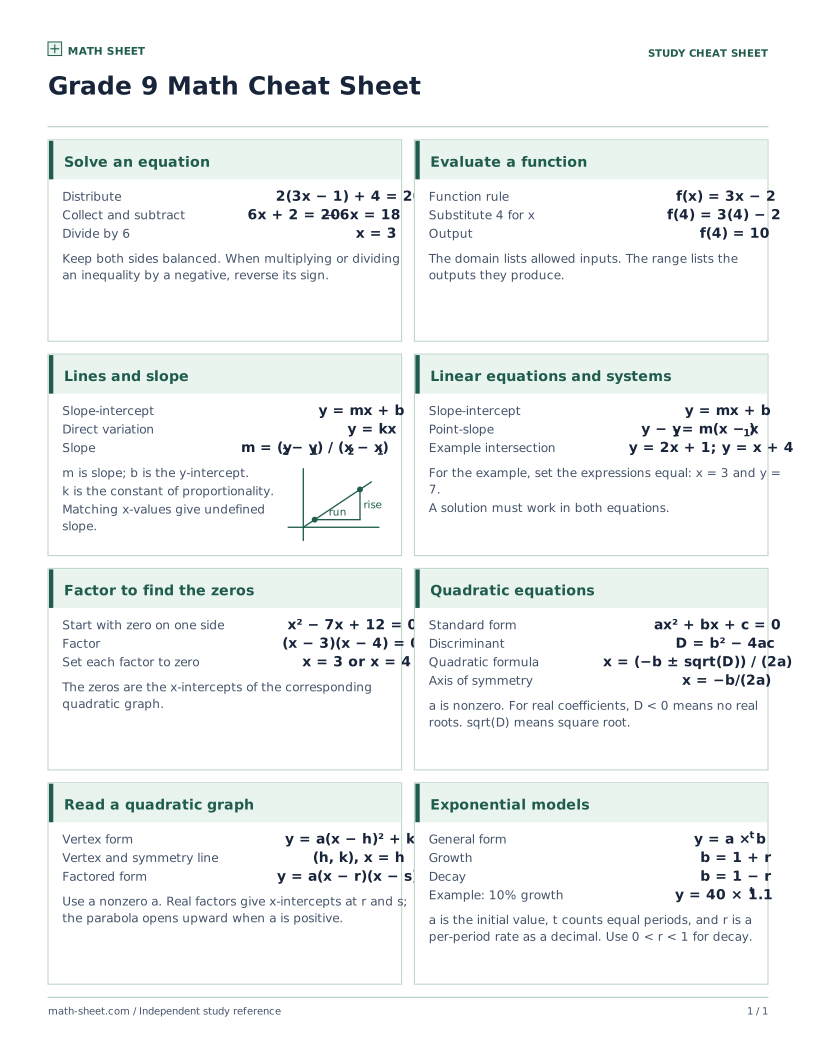
m is slope; b is the y-intercept.
k is the constant of proportionality.
Matching x-values give undefined slope.
Linear equations and systems
- Slope-intercept
- y = mx + b
- Point-slope
- y − y1 = m(x − x1)
- Example intersection
- y = 2x + 1; y = x + 4
For the example, set the expressions equal: x = 3 and y = 7.
A solution must work in both equations.
Factor to find the zeros
- Start with zero on one side
- x² − 7x + 12 = 0
- Factor
- (x − 3)(x − 4) = 0
- Set each factor to zero
- x = 3 or x = 4
The zeros are the x-intercepts of the corresponding quadratic graph.
Quadratic equations
- Standard form
- ax² + bx + c = 0
- Discriminant
- D = b² − 4ac
- Quadratic formula
- x = (−b ± sqrt(D)) / (2a)
- Axis of symmetry
- x = −b/(2a)
a is nonzero. For real coefficients, D < 0 means no real roots. sqrt(D) means square root.
Read a quadratic graph
- Vertex form
- y = a(x − h)² + k
- Vertex and symmetry line
- (h, k), x = h
- Factored form
- y = a(x − r)(x − s)
Use a nonzero a. Real factors give x-intercepts at r and s; the parabola opens upward when a is positive.
Exponential models
- General form
- y = a × bt
- Growth
- b = 1 + r
- Decay
- b = 1 − r
- Example: 10% growth
- y = 40 × 1.1t
a is the initial value, t counts equal periods, and r is a per-period rate as a decimal. Use 0 < r < 1 for decay.