Precalculus practice

Complex Numbers in Polar Form

Convert polar and rectangular forms, multiply and divide, apply De Moivre's theorem, and list all roots through fourth degree.

Ready-made English PDF · fixed settings

Customization below makes a separate PDF.

Fixed English ready-made files. Custom settings below apply only to the configured PDF.

Ready to print

Start with a ready-made worksheet

Use exact modulus and standard angles. For roots, list every distinct root around one complete turn.

Download the practice pages alone, or include a separate answer key or teacher model. Longer activities may use more than one page.

Customize this worksheet

Paper sizes and printing help · More precalculus activities

Keep exact structure and restrictions visible

These worksheets pair exact algebra with labeled graph scales, explicit domains, bounded intervals, and model assumptions. The generated teacher key uses the same resolved task document as the student preview.

Learning objective

What this activity builds

Use modulus and argument to perform exact polar-form operations and display every distinct nth root.

Worked example

Find the cube roots of 1.

Arguments 0, 2pi/3, and 4pi/3, all with modulus 1.

Divide theta+2kpi by 3 for k=0,1,2.

Teaching notes

Make the practice count

  • Multiply moduli and add arguments for products.
  • Reduce arguments only after the operation.
  • Count roots before writing them to avoid omissions.

Make it yours

Customize the practice

Choose your options, update the preview, then download the exact same pages.

Choose the task families and representations to practice. All controls are bounded; keep the seed to reproduce the same numerical givens.

Worksheet settings

Tasks
Page note and reproducible seed

The same settings and seed make the same questions. Shared links include your page note; leave personal information out.

Configured PDF · Complex Numbers in Polar Form · US Letter

Preview ready. Download includes these exact pages.

4 student pages
Enlarged pages scroll. PDF size stays the same.
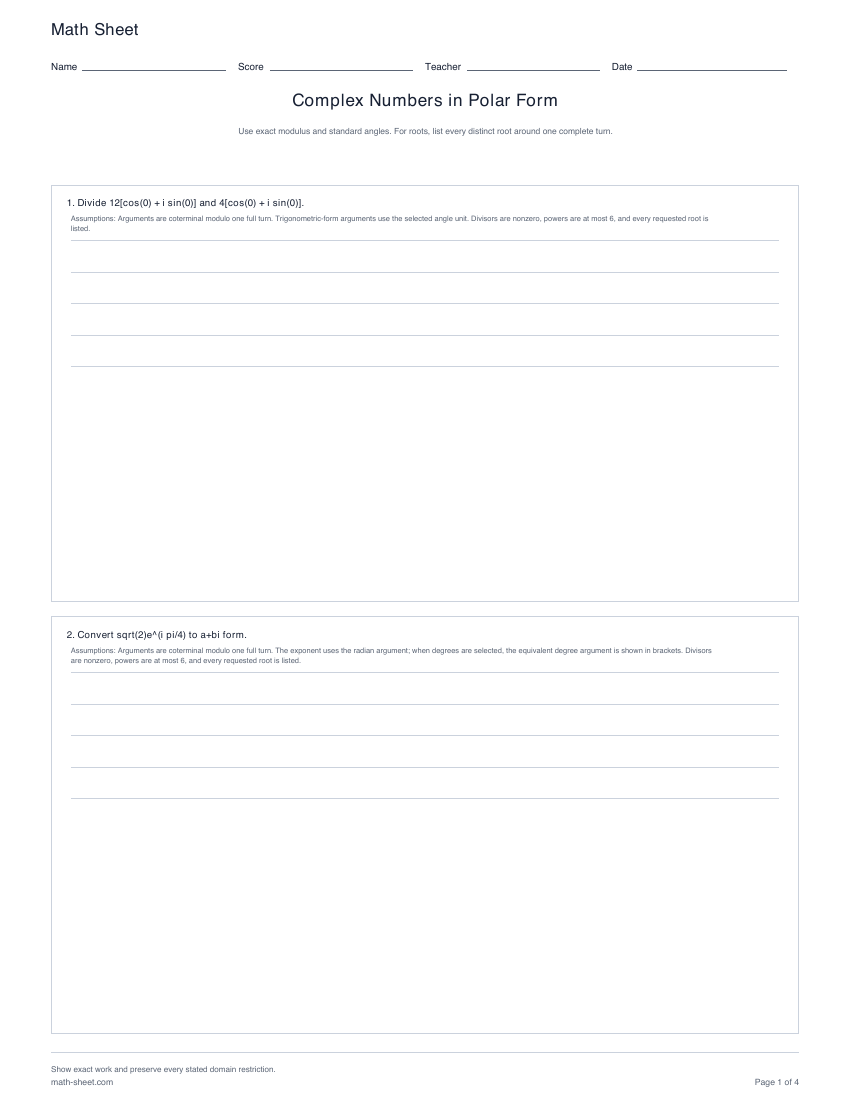
Math SheetNameScoreTeacherDateComplex Numbers in Polar FormUse exact modulus and standard angles. For roots, list every distinct root around one complete turn.1. Divide 12[cos(0) + i sin(0)] and 4[cos(0) + i sin(0)].Assumptions: Arguments are coterminal modulo one full turn. Trigonometric-form arguments use the selected angle unit. Divisors are nonzero, powers are at most 6, and every requested root islisted.2. Convert sqrt(2)e^(i pi/4) to a+bi form.Assumptions: Arguments are coterminal modulo one full turn. The exponent uses the radian argument; when degrees are selected, the equivalent degree argument is shown in brackets. Divisorsare nonzero, powers are at most 6, and every requested root is listed.Show exact work and preserve every stated domain restriction.math-sheet.comPage 1 of 4
Math SheetNameScoreTeacherDateComplex Numbers in Polar FormUse exact modulus and standard angles. For roots, list every distinct root around one complete turn.3. Convert z = 0 + 6i to trigonometric polar form.Assumptions: Arguments are coterminal modulo one full turn. Trigonometric-form arguments use the selected angle unit. Divisors are nonzero, powers are at most 6, and every requested root islisted.4. Use De Moivre's theorem to find [9e^(i 5pi/3)]^4.Assumptions: Arguments are coterminal modulo one full turn. The exponent uses the radian argument; when degrees are selected, the equivalent degree argument is shown in brackets. Divisorsare nonzero, powers are at most 6, and every requested root is listed.Show exact work and preserve every stated domain restriction.math-sheet.comPage 2 of 4
Math SheetNameScoreTeacherDateComplex Numbers in Polar FormUse exact modulus and standard angles. For roots, list every distinct root around one complete turn.5. Find all 4th roots of 4096[cos(5pi/6) + i sin(5pi/6)].Assumptions: Arguments are coterminal modulo one full turn. Trigonometric-form arguments use the selected angle unit. Divisors are nonzero, powers are at most 6, and every requested root islisted.6. Multiply 7e^(i pi) and 5e^(i pi).Assumptions: Arguments are coterminal modulo one full turn. The exponent uses the radian argument; when degrees are selected, the equivalent degree argument is shown in brackets. Divisorsare nonzero, powers are at most 6, and every requested root is listed.Show exact work and preserve every stated domain restriction.math-sheet.comPage 3 of 4
Math SheetNameScoreTeacherDateComplex Numbers in Polar FormUse exact modulus and standard angles. For roots, list every distinct root around one complete turn.7. Use De Moivre's theorem to find [11[cos(3pi/2) + i sin(3pi/2)]]^6.Assumptions: Arguments are coterminal modulo one full turn. Trigonometric-form arguments use the selected angle unit. Divisors are nonzero, powers are at most 6, and every requested root islisted.8. Divide 10e^(i 3pi/2) and 4e^(i 3pi/2).Assumptions: Arguments are coterminal modulo one full turn. The exponent uses the radian argument; when degrees are selected, the equivalent degree argument is shown in brackets. Divisorsare nonzero, powers are at most 6, and every requested root is listed.Show exact work and preserve every stated domain restriction.math-sheet.comPage 4 of 4

A useful next step

Related activities

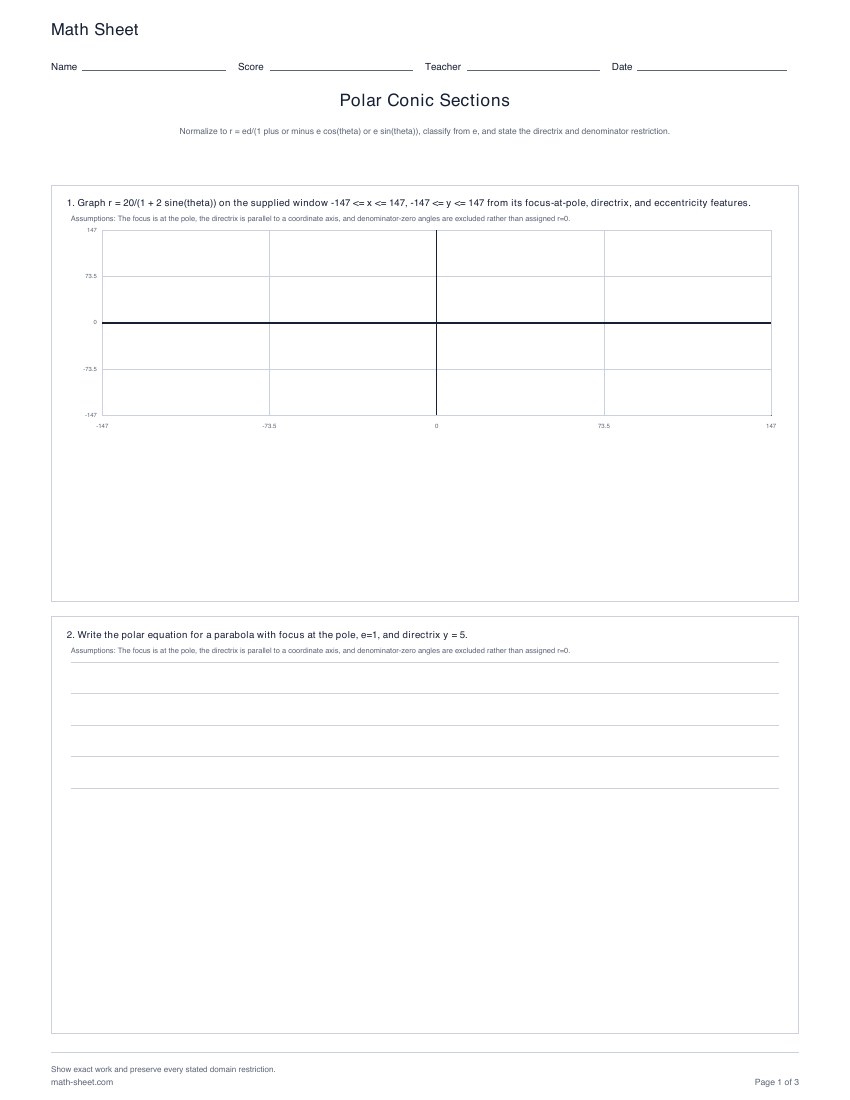
Printable polar conic sections preview

Precalculus

Polar Conic Sections

Normalize, classify, graph, and write focus-at-pole polar conics from eccentricity and an axis-parallel directrix.

Preview and download