Calculus practice

Summation Properties worksheets

Evaluate finite sums with linearity, supplied sums, constant sums, and power-sum formulas through cubes.

Ready-made English PDF · fixed settings

Customization below makes a separate PDF.
Fixed English ready-made files. Custom settings below apply only to the configured PDF.

Ready to print

Start with a ready-made worksheet

Use summation properties to evaluate each of twelve sums. Show the property and substitutions.

Download the practice pages alone, or include a separate answer key or teacher model. Longer activities may use more than one page.

Customize this worksheet

Paper sizes and printing help · More calculus activities

Learning objective

What this activity builds

Separate sums, factor out coefficients, and use the correct lower and upper bounds.

Worked example

If the sum of u(i) from i=2 to5 is10, what is the sum of 3u(i)+2 over those bounds?

3(10) + 2(4) = 38.

Take the coefficient outside the sum. There are 5-2+1=4 constant terms.

Teaching notes

Make the practice count

  • Keep the same bounds when splitting a sum.
  • For a lower bound above1, subtract the prefix ending at lower-1.
  • The index letter does not change the value.

Make it yours

Customize the practice

Choose your options, update the preview, then download the exact same pages.

Twelve sums combine supplied totals, constant sums, and powers through cubes. Choose one index letter or mix letters between problems.

Worksheet settings

Page note and reproducible seed

The same settings and seed make the same questions. Shared links include your page note; leave personal information out.

Configured PDF · Summation Properties · US Letter

Preview ready. Download includes these exact pages.

4 student pages
Enlarged pages scroll. PDF size stays the same.
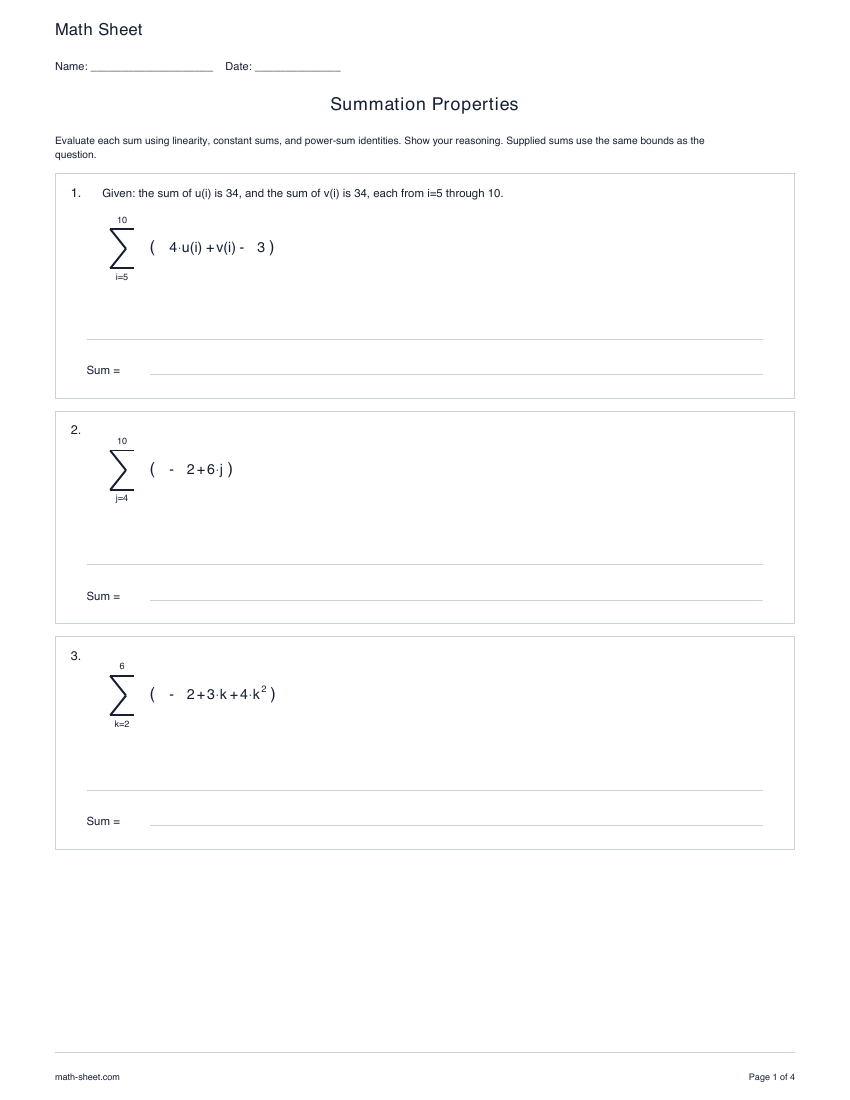
Math SheetName: ____________________ Date: ______________Summation PropertiesEvaluate each sum using linearity, constant sums, and power-sum identities. Show your reasoning. Supplied sums use the same bounds as thequestion.1.Given: the sum of u(i) is 34, and the sum of v(i) is 34, each from i=5 through 10.10i=5()4·u(i)+v(i)-3Sum =2.10j=4()-2+6·jSum =3.6k=2()-2+3·k+4·k2Sum =math-sheet.comPage 1 of 4
Math SheetName: ____________________ Date: ______________Summation PropertiesEvaluate each sum using linearity, constant sums, and power-sum identities. Show your reasoning. Supplied sums use the same bounds as thequestion.4.Given: the sum of u(n) is -6, and the sum of v(n) is 9, each from n=1 through 7.7n=1()6·u(n)+v(n)-2Sum =5.15i=4()1Sum =6.18j=5()2+3·jSum =math-sheet.comPage 2 of 4
Math SheetName: ____________________ Date: ______________Summation PropertiesEvaluate each sum using linearity, constant sums, and power-sum identities. Show your reasoning. Supplied sums use the same bounds as thequestion.7.Given: the sum of u(k) is -21, and the sum of v(k) is 14, each from k=3 through 16.16k=3()-5·u(k)-2·v(k)+6Sum =8.17n=4()-5+n+2·n2-4·n3Sum =9.9i=2()1Sum =math-sheet.comPage 3 of 4
Math SheetName: ____________________ Date: ______________Summation PropertiesEvaluate each sum using linearity, constant sums, and power-sum identities. Show your reasoning. Supplied sums use the same bounds as thequestion.10.Given: the sum of u(j) is 30, and the sum of v(j) is 30, each from j=4 through 12.12j=4()u(j)-v(j)Sum =11.7k=1()2-3·k+3·k2Sum =12.6n=3()-5-n+4·n3Sum =math-sheet.comPage 4 of 4