Calculus practice

Inverse Function Derivatives by Formula worksheets

Apply the inverse-function derivative theorem to polynomial functions, write g' in terms of g, and evaluate exact point derivatives on certified local branches.

Ready-made English PDF · fixed settings

Customization below makes a separate PDF.
Fixed English ready-made files. Custom settings below apply only to the configured PDF.

Ready to print

Start with a ready-made worksheet

Differentiate f, write g' in terms of g using the inverse-function derivative theorem, then evaluate the requested exact point derivative.

Download the practice pages alone, or include a separate answer key or teacher model. Longer activities may use more than one page.

Customize this worksheet

Paper sizes and printing help · More calculus activities

Keep the function-level formula

Every task asks for the complete rule g' in terms of g before evaluating it at the known inverse value.

Learning objective

What this activity builds

Derive g'(x) = 1/f'(g(x)) and use a known inverse value g(b) = a to calculate g'(b) exactly.

Worked example

If f(x) = x^3 + x and g(2) = 1, find g'(x) and g'(2).

g'(x) = 1/(3g(x)^2 + 1), and g'(2) = 1/4.

Differentiate f, substitute g(x) into f', then use g(2) = 1. Since f'(1) = 4 is nonzero, f has a local inverse near 1.

Teaching notes

Make the practice count

  • Differentiate f before substituting the inverse value.
  • Keep g(x) inside the function-level formula.
  • Use g(b) = a only when evaluating g'(b) = 1/f'(a).

Make it yours

Customize the practice

Choose your options, update the preview, then download the exact same pages.

Choose 12 or 24 problems, set the largest polynomial degree, and use x throughout or cycle through x, t, u, v, w and z.

Worksheet settings

Page note and reproducible seed

The same settings and seed make the same questions. Shared links include your page note; leave personal information out.

Configured PDF · Inverse Function Derivatives by Formula · US Letter

Preview ready. Download includes these exact pages.

2 student pages
Enlarged pages scroll. PDF size stays the same.
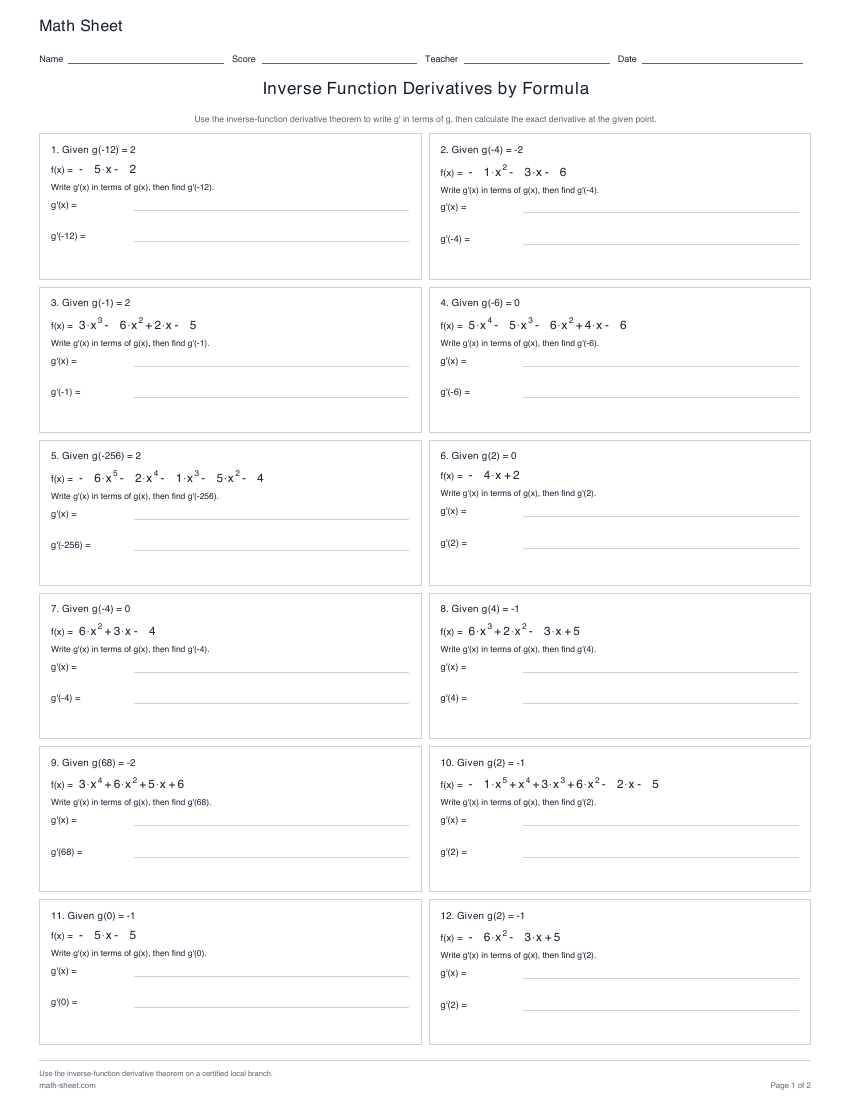
Math SheetNameScoreTeacherDateInverse Function Derivatives by FormulaUse the inverse-function derivative theorem to write g' in terms of g, then calculate the exact derivative at the given point.1. Given g(-12) = 2f(x) =-5·x-2Write g'(x) in terms of g(x), then find g'(-12).g'(x) =g'(-12) =2. Given g(-4) = -2f(x) =-1·x2-3·x-6Write g'(x) in terms of g(x), then find g'(-4).g'(x) =g'(-4) =3. Given g(-1) = 2f(x) =3·x3-6·x2+2·x-5Write g'(x) in terms of g(x), then find g'(-1).g'(x) =g'(-1) =4. Given g(-6) = 0f(x) =5·x4-5·x3-6·x2+4·x-6Write g'(x) in terms of g(x), then find g'(-6).g'(x) =g'(-6) =5. Given g(-256) = 2f(x) =-6·x5-2·x4-1·x3-5·x2-4Write g'(x) in terms of g(x), then find g'(-256).g'(x) =g'(-256) =6. Given g(2) = 0f(x) =-4·x+2Write g'(x) in terms of g(x), then find g'(2).g'(x) =g'(2) =7. Given g(-4) = 0f(x) =6·x2+3·x-4Write g'(x) in terms of g(x), then find g'(-4).g'(x) =g'(-4) =8. Given g(4) = -1f(x) =6·x3+2·x2-3·x+5Write g'(x) in terms of g(x), then find g'(4).g'(x) =g'(4) =9. Given g(68) = -2f(x) =3·x4+6·x2+5·x+6Write g'(x) in terms of g(x), then find g'(68).g'(x) =g'(68) =10. Given g(2) = -1f(x) =-1·x5+x4+3·x3+6·x2-2·x-5Write g'(x) in terms of g(x), then find g'(2).g'(x) =g'(2) =11. Given g(0) = -1f(x) =-5·x-5Write g'(x) in terms of g(x), then find g'(0).g'(x) =g'(0) =12. Given g(2) = -1f(x) =-6·x2-3·x+5Write g'(x) in terms of g(x), then find g'(2).g'(x) =g'(2) =Use the inverse-function derivative theorem on a certified local branch.math-sheet.comPage 1 of 2
Math SheetNameScoreTeacherDateInverse Function Derivatives by FormulaUse the inverse-function derivative theorem to write g' in terms of g, then calculate the exact derivative at the given point.13. Given g(19) = -2f(x) =-5·x3-6·x2+3Write g'(x) in terms of g(x), then find g'(19).g'(x) =g'(19) =14. Given g(-12) = -1f(x) =-6·x4+3·x3+2·x2-1·x-6Write g'(x) in terms of g(x), then find g'(-12).g'(x) =g'(-12) =15. Given g(6) = 0f(x) =6·x5+x4+6·x3-5·x2-4·x+6Write g'(x) in terms of g(x), then find g'(6).g'(x) =g'(6) =16. Given g(-18) = 2f(x) =-6·x-6Write g'(x) in terms of g(x), then find g'(-18).g'(x) =g'(-18) =17. Given g(13) = -2f(x) =4·x2-3Write g'(x) in terms of g(x), then find g'(13).g'(x) =g'(13) =18. Given g(6) = 1f(x) =-4·x3+5·x2+x+4Write g'(x) in terms of g(x), then find g'(6).g'(x) =g'(6) =19. Given g(-6) = 1f(x) =-6·x4-3·x3-6·x2+5·x+4Write g'(x) in terms of g(x), then find g'(-6).g'(x) =g'(-6) =20. Given g(-18) = -1f(x) =6·x5-4·x4-1·x3-1·x2+6·x-2Write g'(x) in terms of g(x), then find g'(-18).g'(x) =g'(-18) =21. Given g(2) = 0f(x) =-5·x+2Write g'(x) in terms of g(x), then find g'(2).g'(x) =g'(2) =22. Given g(4) = 1f(x) =5·x2+3·x-4Write g'(x) in terms of g(x), then find g'(4).g'(x) =g'(4) =23. Given g(2) = 0f(x) =-6·x3-1·x2-3·x+2Write g'(x) in terms of g(x), then find g'(2).g'(x) =g'(2) =24. Given g(0) = 1f(x) =6·x4+3·x3-6·x2-3·xWrite g'(x) in terms of g(x), then find g'(0).g'(x) =g'(0) =Use the inverse-function derivative theorem on a certified local branch.math-sheet.comPage 2 of 2