Calculus practice

Accumulation, Average Value, and Net Change worksheets

Interpret definite integrals as signed change, average value, and recovery from an initial amount.

Ready-made English PDF · fixed settings

Customization below makes a separate PDF.

Fixed English ready-made files. Custom settings below apply only to the configured PDF.

Ready to print

Start with a ready-made worksheet

Interpret definite integrals as signed change, average value, and recovery from an initial amount.

Download the practice pages alone, or include a separate answer key or teacher model. Longer activities may use more than one page.

Customize this worksheet

Paper sizes and printing help · More calculus activities

Method, assumptions, and units stay visible

Each generated problem includes bounded solvable givens. Worked pages show the theorem, formula, substitution, or physical slice used to reach the result.

Learning objective

What this activity builds

Connect rate integrals to contextual quantities and units.

Worked example

What must be shown in a accumulation solution?

The governing formula, substituted givens, and a labeled conclusion.

The worked key keeps the mathematical method visible rather than displaying only a result.

Teaching notes

Make the practice count

  • Keep units or domains beside each line.
  • Ask students to name the theorem or formula before substituting.
  • Distinguish exact values from labeled approximations.

Make it yours

Customize the practice

Choose your options, update the preview, then download the exact same pages.

Choose the mathematical families and response modes. Keep the seed to reproduce the same givens and worked key.

Worksheet settings

Interpretations
Rate sources
Page note and reproducible seed

The same settings and seed make the same questions. Shared links include your page note; leave personal information out.

Configured PDF · Accumulation, Average Value, and Net Change · US Letter

Preview ready. Download includes these exact pages.

3 student pages
Enlarged pages scroll. PDF size stays the same.
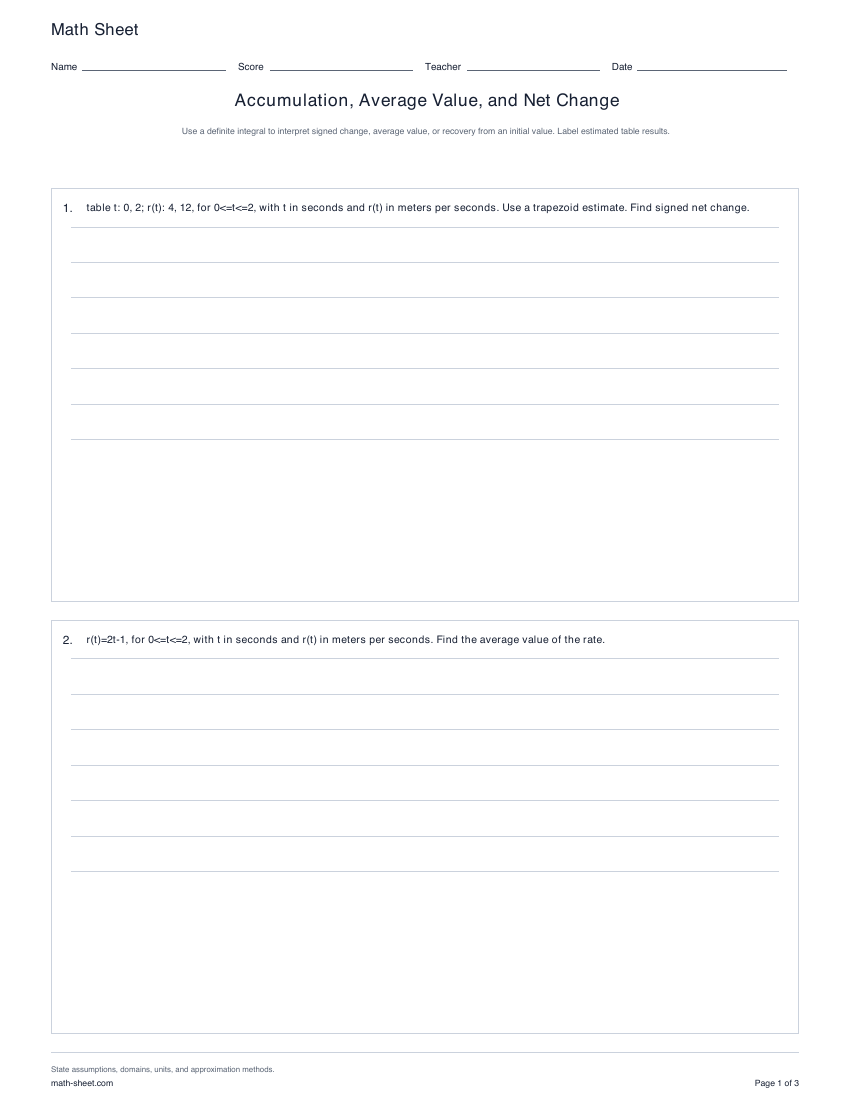
Math SheetNameScoreTeacherDateAccumulation, Average Value, and Net ChangeUse a definite integral to interpret signed change, average value, or recovery from an initial value. Label estimated table results.1.table t: 0, 2; r(t): 4, 12, for 0<=t<=2, with t in seconds and r(t) in meters per seconds. Use a trapezoid estimate. Find signed net change.2.r(t)=2t-1, for 0<=t<=2, with t in seconds and r(t) in meters per seconds. Find the average value of the rate.State assumptions, domains, units, and approximation methods.math-sheet.comPage 1 of 3
Math SheetNameScoreTeacherDateAccumulation, Average Value, and Net ChangeUse a definite integral to interpret signed change, average value, or recovery from an initial value. Label estimated table results.3.r(t)=3t-3, for 0<=t<=4, with t in seconds and r(t) in meters per seconds. Find signed net change.4.r(t)=2t+3, for 0<=t<=3, with t in seconds and r(t) in meters per seconds. If Q(0)=11 meters, find Q(3).State assumptions, domains, units, and approximation methods.math-sheet.comPage 2 of 3
Math SheetNameScoreTeacherDateAccumulation, Average Value, and Net ChangeUse a definite integral to interpret signed change, average value, or recovery from an initial value. Label estimated table results.5.table t: 0, 2; r(t): 2, 6, for 0<=t<=2, with t in seconds and r(t) in meters per seconds. Use a trapezoid estimate. If Q(0)=17 meters, find Q(2).6.table t: 0, 3; r(t): -2, 10, for 0<=t<=3, with t in seconds and r(t) in meters per seconds. Use a trapezoid estimate. Find the average value of therate.State assumptions, domains, units, and approximation methods.math-sheet.comPage 3 of 3

A useful next step

Related activities